Best Maze Books for Kids (2026 Picks by Age and Skill)
Mazes are the first puzzle most children can do before they can read, and one of the few that still works at eleven. That's the problem with shopping for them: a three-year-old dragging a finger down a wide corridor and a ten-year-old scanning ahead to rule out three dead ends before the pencil moves are doing completely different cognitive work on pages that look roughly the same in a thumbnail. "Mazes for kids" as a search term is close to useless without an age attached, so this guide attaches one to every pick. Note on this site: we publish maze books for kids ourselves, and ours is below, flagged as ours. Judge it accordingly. The rest are what we'd buy as parents, and each pick lists the thing it does badly — including ours.
How we chose
Difficulty that actually climbs
The most common failure in a maze book is 100 mazes at one level: the kid solves the first six, learns nothing new, and stops. A good book gets measurably harder — longer routes, more branch points, more convincing dead ends — and does it gradually enough that no page feels like a wall. Flip to the back of the interior preview; if the last maze looks like the first, it's a padded book.
Path width for small hands
Corridor width is the single most age-sensitive thing in a maze book, and almost nobody puts it on the cover. A three- or four-year-old needs a path wide enough for a crayon plus wobble — roughly a centimeter or more. By six or seven a pencil-width path is fine, and past nine, narrow paths are part of the challenge. A maze that's conceptually right but drawn too tight produces a frustrated kid and a scribbled page.
Theme or story, or plain line mazes
Illustrated mazes — help the dog reach the bone, get through the pirate ship — carry younger children a long way, because the picture supplies a reason to care. Plain line mazes are better puzzles: nothing competes with the path, and difficulty is easier to control. Under six, buy themed. Past eight, most kids prefer the clean version and solve more of them.
Paper weight, because kids reach for markers
Mazes get solved with whatever is on the table, and that's often a marker. Thin paper bleeds onto the next maze and ruins it before anyone attempts it. Heavier bright-white stock also keeps a pencil line visible against printed maze walls, which matters more than it sounds when a child is trying to see where they've already been.
Our top picks by age
- #1
Sunlight Kids — Mazes for Kids: Easy, Medium & Hard
Ages 6–12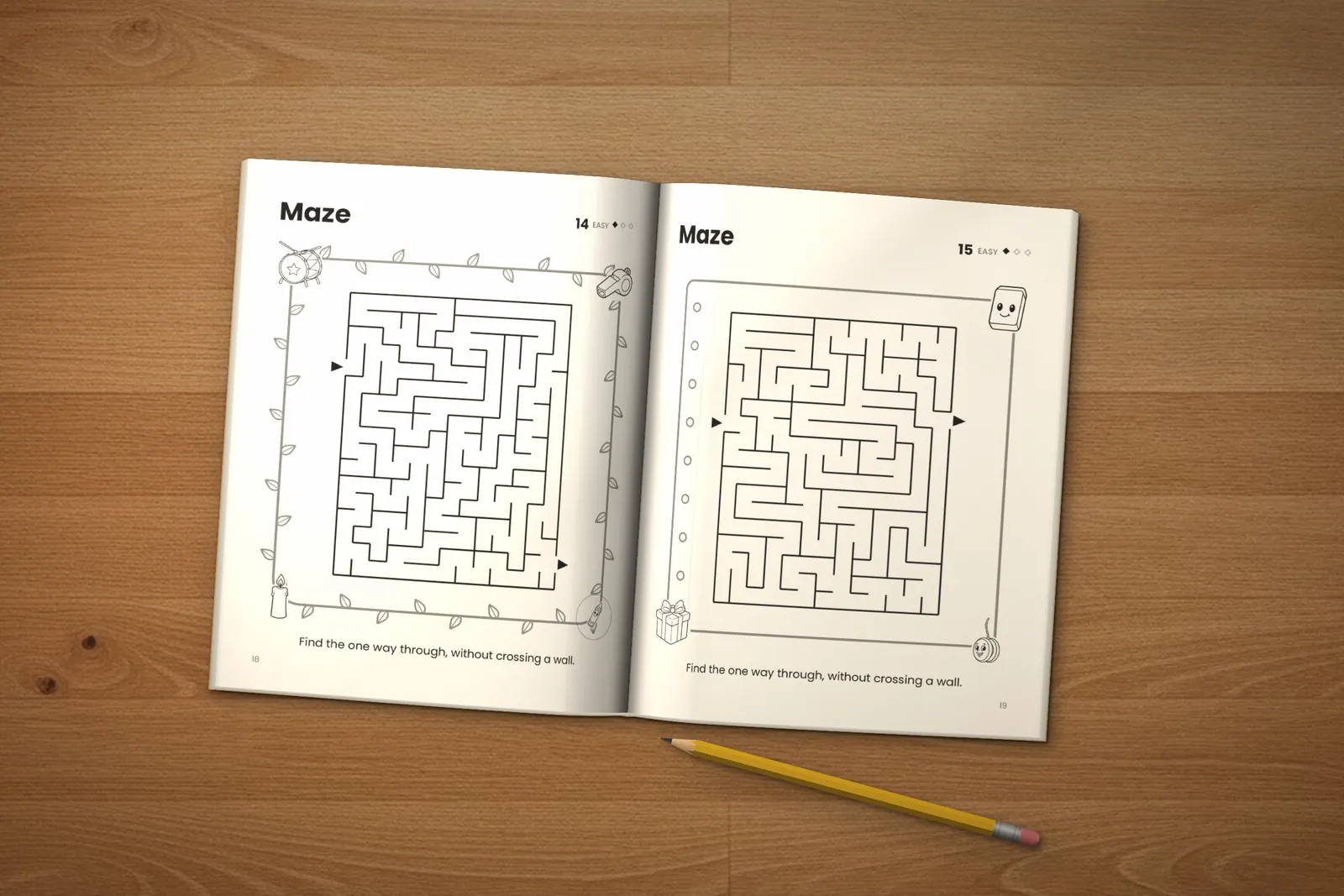
Best for the long run — a book a seven-year-old starts and an eleven-year-old is still finishing. 100 mazes across three bands (34 easy, 33 medium, 33 hard), one per page on a large 8 × 10 trim so the paths stay wide even as the routes get long. Every maze has real branching and genuine dead ends rather than one corridor with decoration, and there's exactly one way out. Full solutions in the back. Weakness: it's a pure line-maze book: no scenes to color in, no story. A four-year-old who wants a picture to look at will do better with one of the illustrated picks below. If you know the level you want, the single-band editions are Easy (ages 6–9), Medium (8–11) and Hard (9–12).
Paperback$10.99In a rush? Download the PDF now and print it at home.
- #2
Kumon maze workbooks (My Book of Mazes, Amazing Mazes)
Ages 3–5Best first maze book, and the clearest ladder in the category. Kumon starts with short, very wide paths a preschooler can trace with a crayon and adds length and turns a page at a time, so the progression is almost invisible to the child. Thick paper, generous trim, and a completion-and-sticker rhythm that keeps a four-year-old going. Weakness: outgrown quickly — most kids are done with the range by six or seven — and it's strictly consumable, so a second child needs a second copy. The later pages also get repetitive; the mazes lengthen without getting cleverer.
- #3
Usborne illustrated maze books
Ages 5–8Best for a child who needs the puzzle to be about something. Usborne's maze books are drawn as scenes — castles, jungles, space stations — with the route running through the illustration, and there's usually a hunt-for-the-hidden-things layer on the same spread, so one page holds a kid for a long time. Weakness: the illustration density that makes them appealing also makes the path genuinely hard to see, and some spreads are more picture than puzzle. Difficulty jumps around rather than climbing, so a child can hit a hard page early and stall.
- #4
Wipe-clean and dry-erase maze pads
Ages 3–6Best for travel, restaurants and second children. The laminated-page format means a maze can be solved, wiped and solved again, which is exactly what a four-year-old wants to do, and there's nothing to tear out or lose. The reuse also takes the sting out of a kid who scribbles over a maze halfway through. Weakness: you're buying a handful of mazes rather than a hundred, the wipe-clean surface smudges under a resting hand, and the included markers dry out fast. Pencil doesn't work on them at all, which rules out the erase-and-rethink habit older kids need.
- #5
Large-format labyrinth and maze books aimed at teens and adults
Ages 10+Best step up for a kid who has stopped finding children's mazes hard. These go where kid books don't — spiral and circular layouts, multi-page mazes, routes that take twenty minutes — and there are plenty of them because adults buy mazes too. Weakness: line weights get very fine, which is a real problem if the child is still solving in marker, and some titles are art books with a path drawn through them rather than well-built puzzles. There's no age guidance at all, so you're judging from the preview image alone.
Maze books for 4 and 5 year olds
At four, a maze is mostly path-tracing: wide corridors, one or two false turns, and a picture at the end worth reaching. Buy illustrated, crayon-width mazes (the Kumon range and wipe-clean pads above). Line-maze books with real dead ends, ours included, usually click between five and six.
Maze books for 6 and 7 year olds
This is the age genuine maze-solving arrives — looking ahead, backing out of a dead end, trying the other branch. Pencil-width paths are fine now. Mazes for Kids: Easy is built for exactly this stage: 100 mazes that start short and grow, one per page.
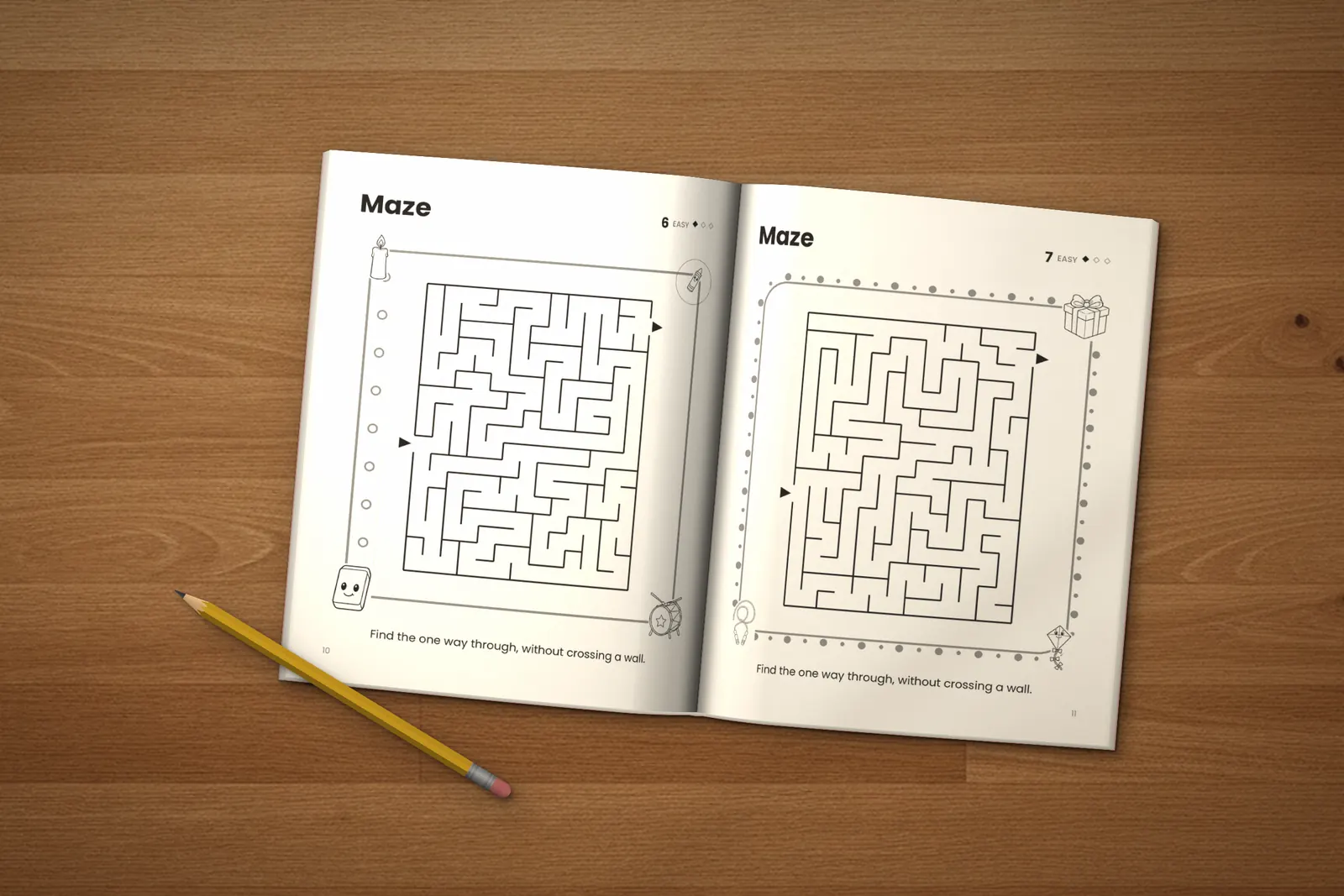
Mazes for Kids: Easy — 100 puzzles, one per page — twists · dead ends · one way out
Maze books for 8, 9 and 10 year olds
By eight most kids find easy mazes boring within a page. They want longer routes, more branch points and dead ends that look convincing. Mazes for Kids: Medium is the right level for most 8–10 year olds. A 10-year-old who flies through it is ready for the hard section of the combined edition.
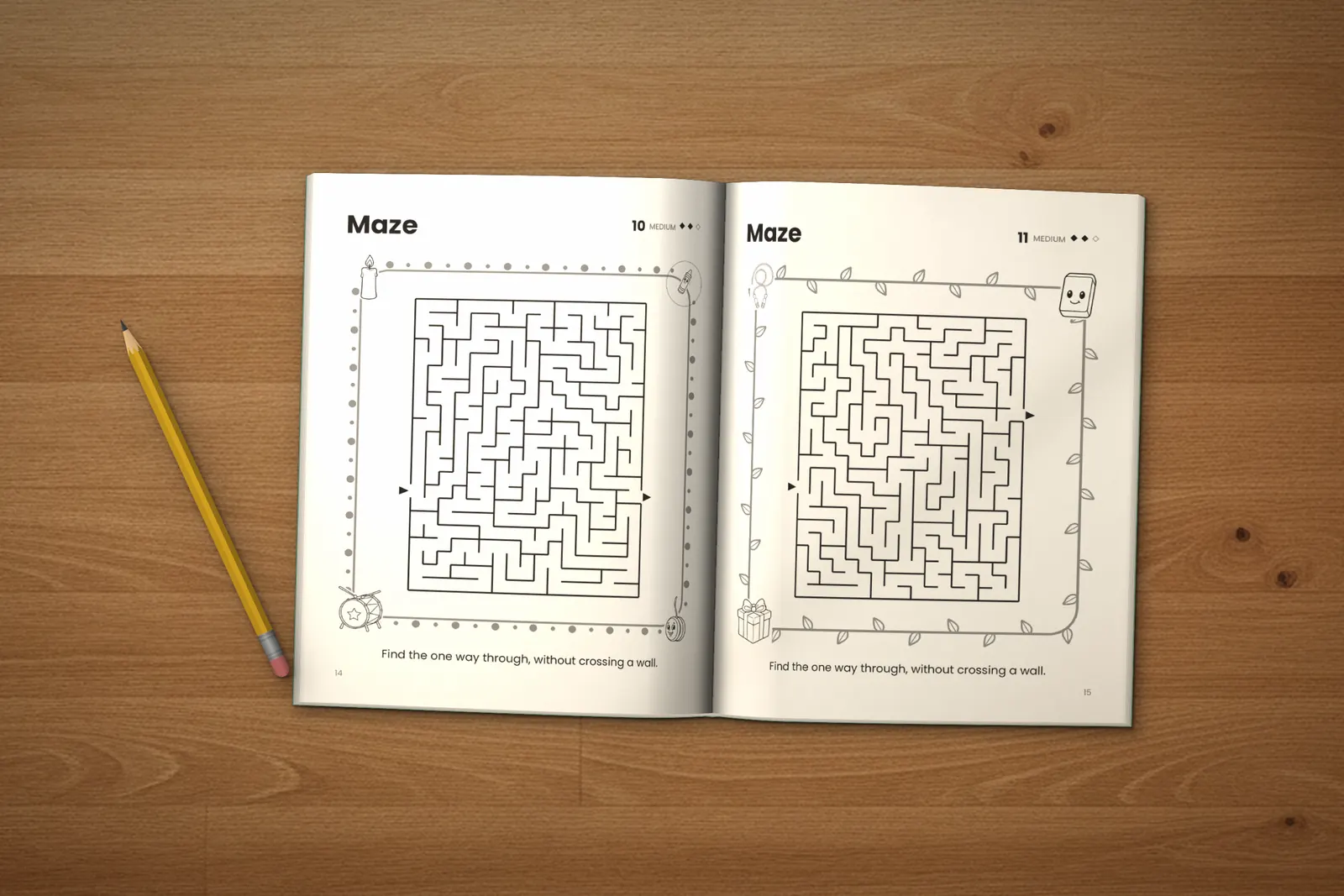
Mazes for Kids: Medium — 100 puzzles, one per page — twists · dead ends · one way out
Maze books for 10, 11 and 12 year olds
Past ten, narrow paths and twenty-minute routes are the point. Mazes for Kids: Hard (ages 9–12) is hard from page one; the combined Easy, Medium & Hard edition ends on its hardest third, so it suits a 10-year-old who is still building up.
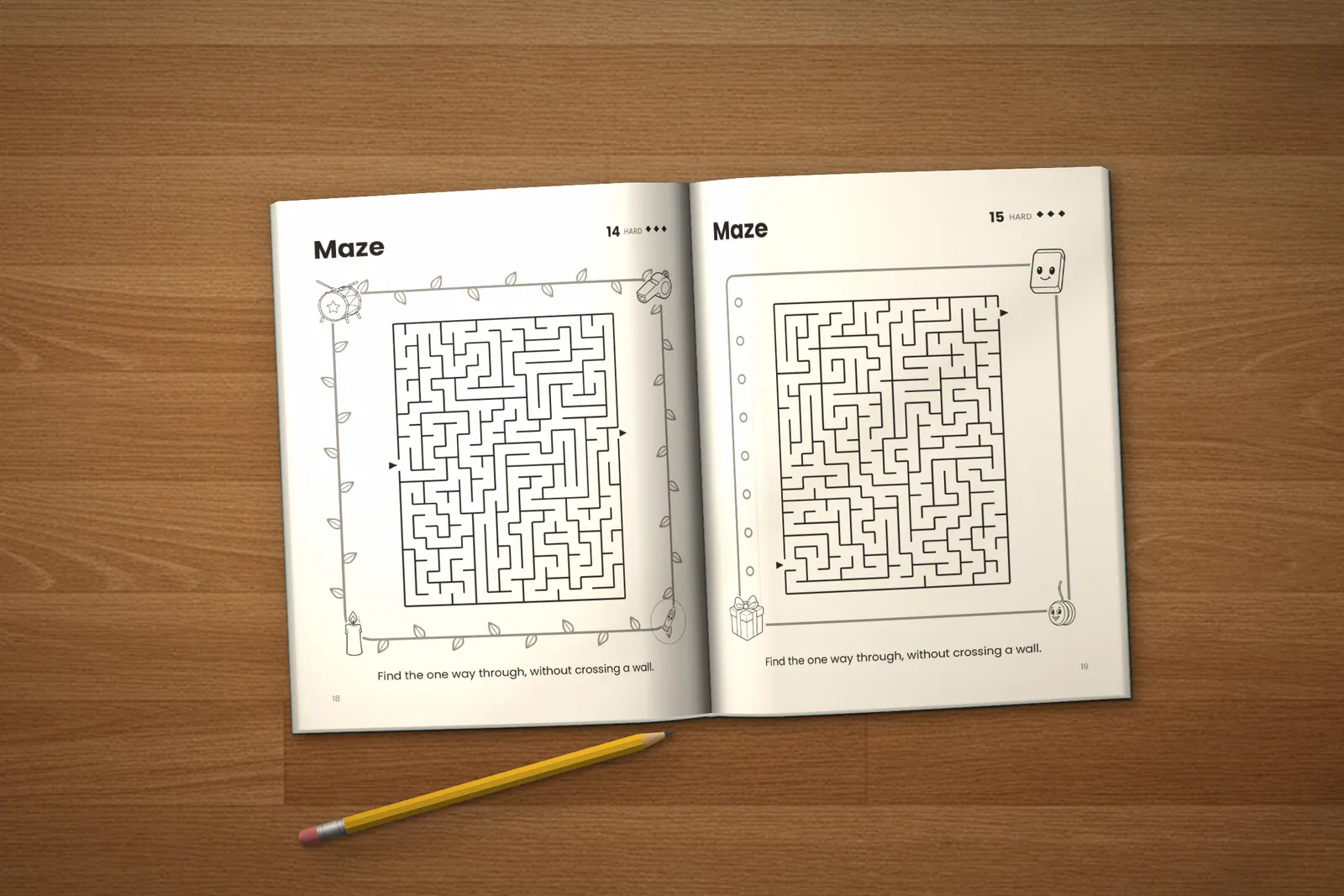
Mazes for Kids: Hard — 100 puzzles, one per page — twists · dead ends · one way out
Mazes for Kids: Easy, Medium & Hard — 100 puzzles, one per page — twists · dead ends · one way out
What to look for in a maze book
One maze per page, printed large
Two mazes to a page halves the path width and doubles the frustration. A large trim size is worth more than a high puzzle count: a hundred mazes a kid can actually draw through beats two hundred they can't.
Real dead ends, not one corridor
Plenty of cheap maze books draw a single winding path with a few stubs off it. It looks like a maze and solves in four seconds, because there's never a decision to make. A real maze has branch points where both options look plausible — that's the part that builds the look-ahead habit.
Solutions in the back
A stuck child needs a way to see the answer that doesn't involve an adult solving it for them, and a solutions section lets them check their own route rather than asking whether they got it right. It also settles the "this one is impossible" argument in about ten seconds.
Think about reuse before you buy
Maze books are consumed once. If two children will share it, or you want the same maze attempted twice, slip pages into a sheet protector and hand over a dry-erase marker — that turns any paperback into a reusable book and is far cheaper than buying two.
DIY vs buy
Being straight about this: we don't have a free maze printable yet. Our free packs live at /printables — sudoku, crosswords, word searches, coloring and dot-marker pages — and a maze pack is on the list, but it isn't there today, so we're not going to pretend otherwise. In the meantime, free online maze generators genuinely do work. They'll produce as many valid mazes as you want in whatever size you set, and for a rainy afternoon that's completely fine. What they don't produce is variety or progression — generator output is uniform by design, so every maze feels like the last one, and there's no path from a four-year-old's first wide corridor to a ten-year-old's twenty-minute route. Drawing mazes on graph paper is also worth trying with kids over seven; building one teaches more about dead ends than solving twenty does. For a book that climbs on purpose, buy the book.
The maze books for kids we wrote ourselves
Ages 2–5 · 4–7 · 7+ · Adults
Frequently asked questions
- What age can kids start doing mazes?
- Around two and a half to three for very short, very wide paths with no branches — that's really path-tracing rather than maze-solving, and it's the right place to start. Simple mazes with one or two false turns land around four. Genuine maze-solving, where a child looks ahead and rules a branch out before committing the pencil, usually arrives between five and seven.
- Are mazes good for handwriting readiness?
- Yes, and it's one of the better reasons to buy them for a preschooler. A maze asks for a controlled continuous line inside a boundary, held for longer than a child would otherwise sit still — that's pencil grip, wrist and finger control, and the left-to-right, top-to-bottom sweep that writing needs, all without any of the pressure of forming letters. It isn't a handwriting program, and it won't teach letter shapes. But for the underlying motor control, mazes and coloring do more real work than tracing worksheets, mostly because kids will keep doing them.
- How do I know a maze book is too hard for my child?
- Watch what they do when they hit a dead end. A child at the right level backs up and tries the other branch; a child in over their head either draws straight through a wall or abandons the page. Two abandoned mazes in a row means drop a level. The other tell is the pencil never lifting — if they're solving purely by momentum rather than looking ahead, the mazes are too easy, not too hard.
- Do mazes help with anything besides being fun?
- They exercise visual planning, spatial reasoning, working memory and impulse control — a maze specifically rewards looking before moving, which is not most six-year-olds' natural setting. Fine-motor control comes along for free. What they won't do is raise test scores; evidence that puzzle practice transfers to unrelated academic skills is thin. Buy them because they hold a child's attention off a screen for half an hour, and take the rest as a bonus.
- Pencil, marker, or finger?
- Finger first for under-fours — it removes the mess and lets them try a wrong branch with no cost. Crayon or thick pencil once they can stay inside the path. Pencil from about six, because erasing is what makes rethinking possible. Markers are what kids reach for and are fine on heavy paper, but they bleed on thin stock and make a wrong turn permanent, which some children mind a great deal.
- Can I buy the Sunlight Kids maze books?
- Yes — Mazes for Kids: Easy (ages 6–9), Medium (8–11) and the combined Easy, Medium & Hard edition are on Amazon now. The Hard-only edition is finished and coming soon. We don't have a free maze printable yet; the free packs at /printables are sudoku, crosswords, word searches and coloring for now.
Sunlight Kids activity books — for every age.
Ages 2–5 · 4–7 · 7+ · Adults