Best Word Search Books for Adults (2026 Picks)
Most word search books sold to adults are not built for adults. They are the same 15×15 grids sold to nine-year-olds with a photograph of a coffee cup on the cover, and a competent solver clears one in four minutes. What separates a genuinely good adult word search book is measurable: grid density, words per puzzle, whether words run in all eight directions including backwards, and — the one almost nobody gets right — whether the filler letters are drawn from the word list or scattered at random, because random filler lets you find long words by shape alone without reading anything. This guide covers the three sub-categories that behave differently in practice: hard puzzles for solvers who want a real fight, large print for anyone reading a grid at arm's length, and themed volumes for people who want the word lists to be about something. To be plain about it: we publish word search books for adults ourselves, so one of the five picks below is ours. The other four we recommend with no stake in them, and every pick here, ours included, gets its honest weakness.
The short answer
- 1.Sunlight Word Search for Adults: Easy, Medium & HardBest overall
- 2.Sunlight Large Print Word Search: Easy, Medium & HardAdults · large print
- 3.Penny Press and Dell word search magazines and compilationsAdults
- 4.Brain Games large print word searchAdults · large print
- 5.Puzzle Baron word search booksAdults
- 6.Mega-compilation word search books (300–1,000 puzzles)Adults
Free printable starter pack
22 pages · Best for ages 12+ and adults
How we chose
Grid density and word count, not page count
A 15×15 grid with 15 words is a warm-up whatever the cover says. Adult-appropriate difficulty starts around 17×17 with 20+ words and gets serious at 20×20 with 30. We counted rows and word lists rather than trusting the words "challenging" or "expert" on the front.
All eight directions, including backwards
Forwards across and down is a solved problem for any adult. Diagonals roughly double solve time and reversals roughly double it again. Any book marketed to adults that quietly runs forwards-only is padding its puzzle count with puzzles nobody needed.
Type size and paper you can actually work on
This is where cheap books fail hardest. Grids printed small enough to fit two per page defeat anyone over about fifty, and thin stock means a ballpoint bleeds through onto the puzzle behind it. We favored bright white paper, one puzzle per page, and — for large print specifically — extra letter spacing rather than just a bigger font crammed into the same grid.
Verified grids and a usable answer key
The most common defect in generated word search books is a word that appears twice by accident, which makes the answer key look wrong and the solver feel wrong. Books that machine-verify each grid for a single solution avoid it. We also checked that the key is laid out so confirming one puzzle doesn't reveal the one printed opposite.
Our top picks
- #1
Sunlight Word Search for Adults: Easy, Medium & Hard
AdultsBest overall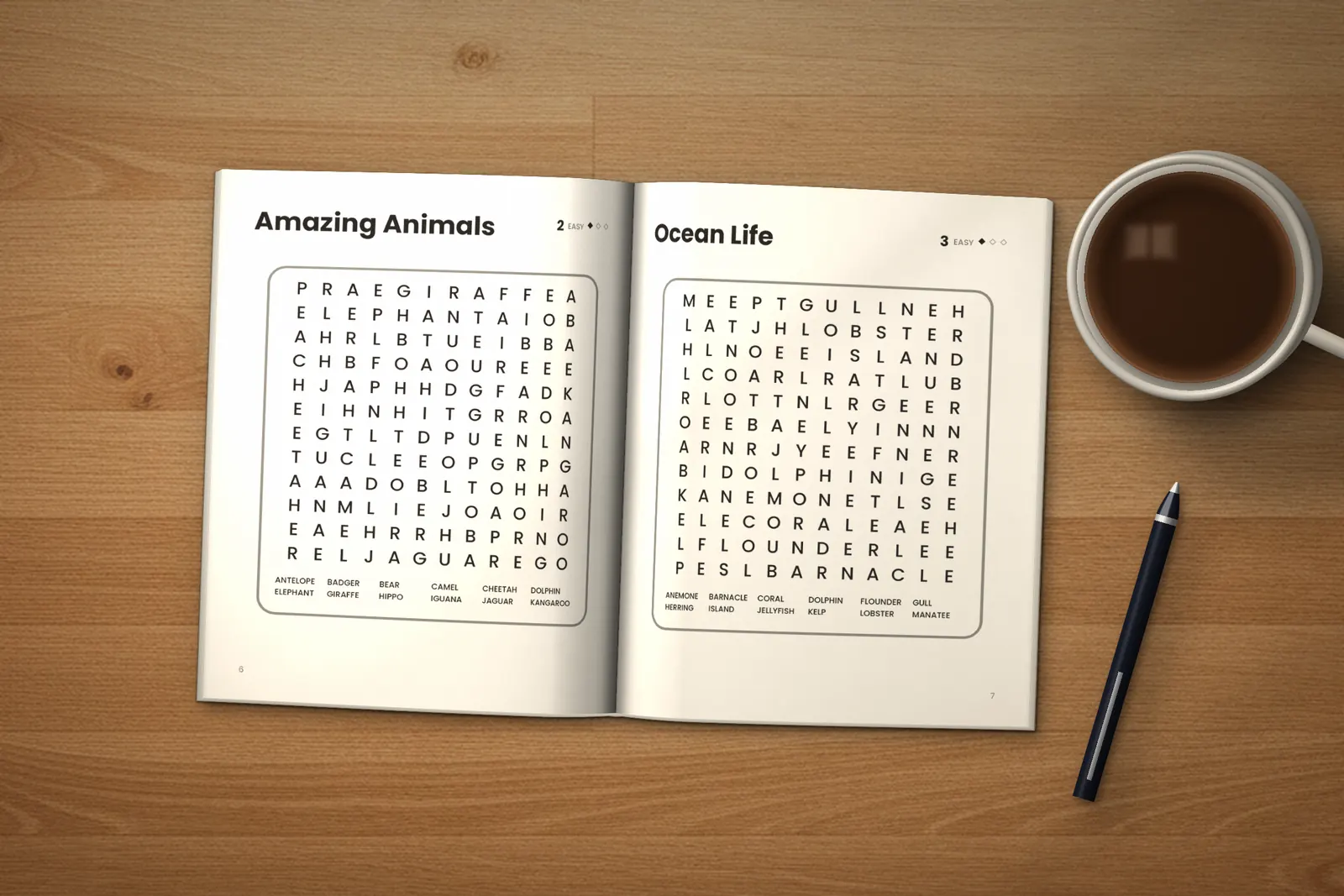
Ours, and the standard-print pick. 100 word searches in one 8×10 volume — 34 easy, 33 medium, 33 hard — one puzzle per page, with a fresh themed word list on every grid and a full answer key in the back. The difficulty climbs on purpose: early grids run across and down, the last third uses all eight directions and backwards words, so the book still has something to say after the first week. Every grid is machine-checked so each word appears exactly once. Paperback on Amazon, or a $4.99 PDF you can print at home. Weakness: 100 puzzles, not 1,000. If you want volume over curation, the mega-compilations below win on price per puzzle.
Paperback$10.99In a rush? Download the PDF now and print it at home.
- #2
Sunlight Large Print Word Search: Easy, Medium & Hard
Adults · large print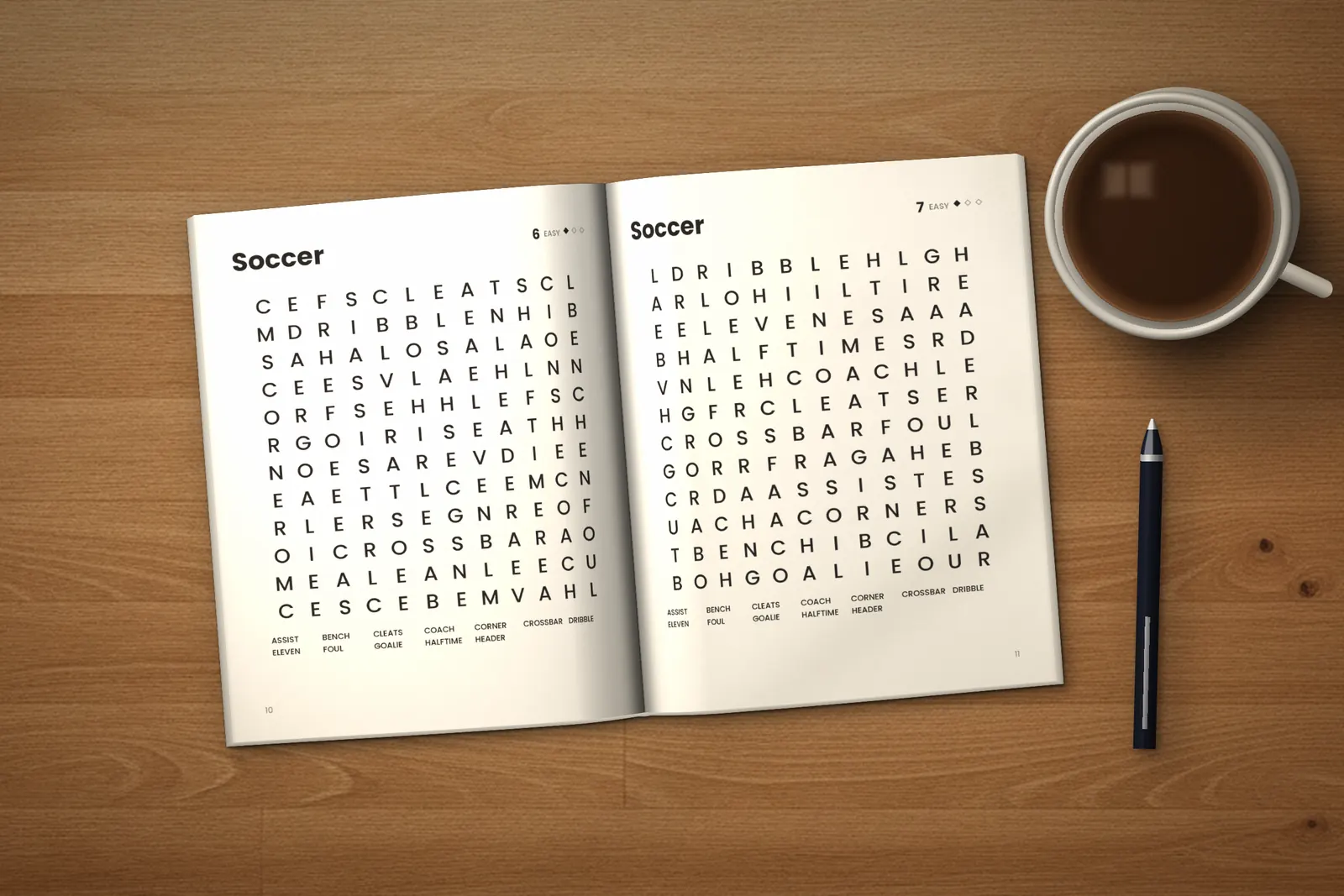
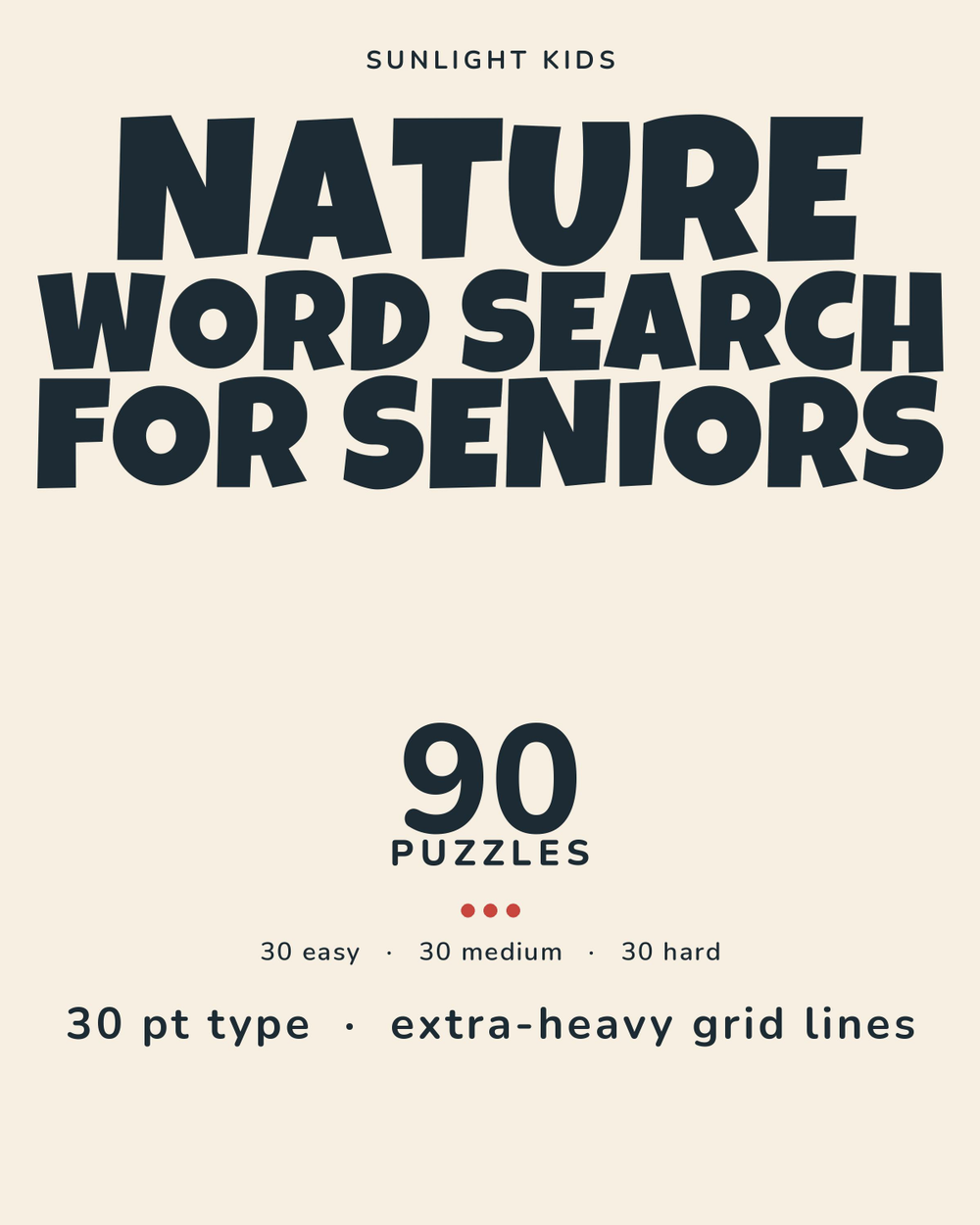
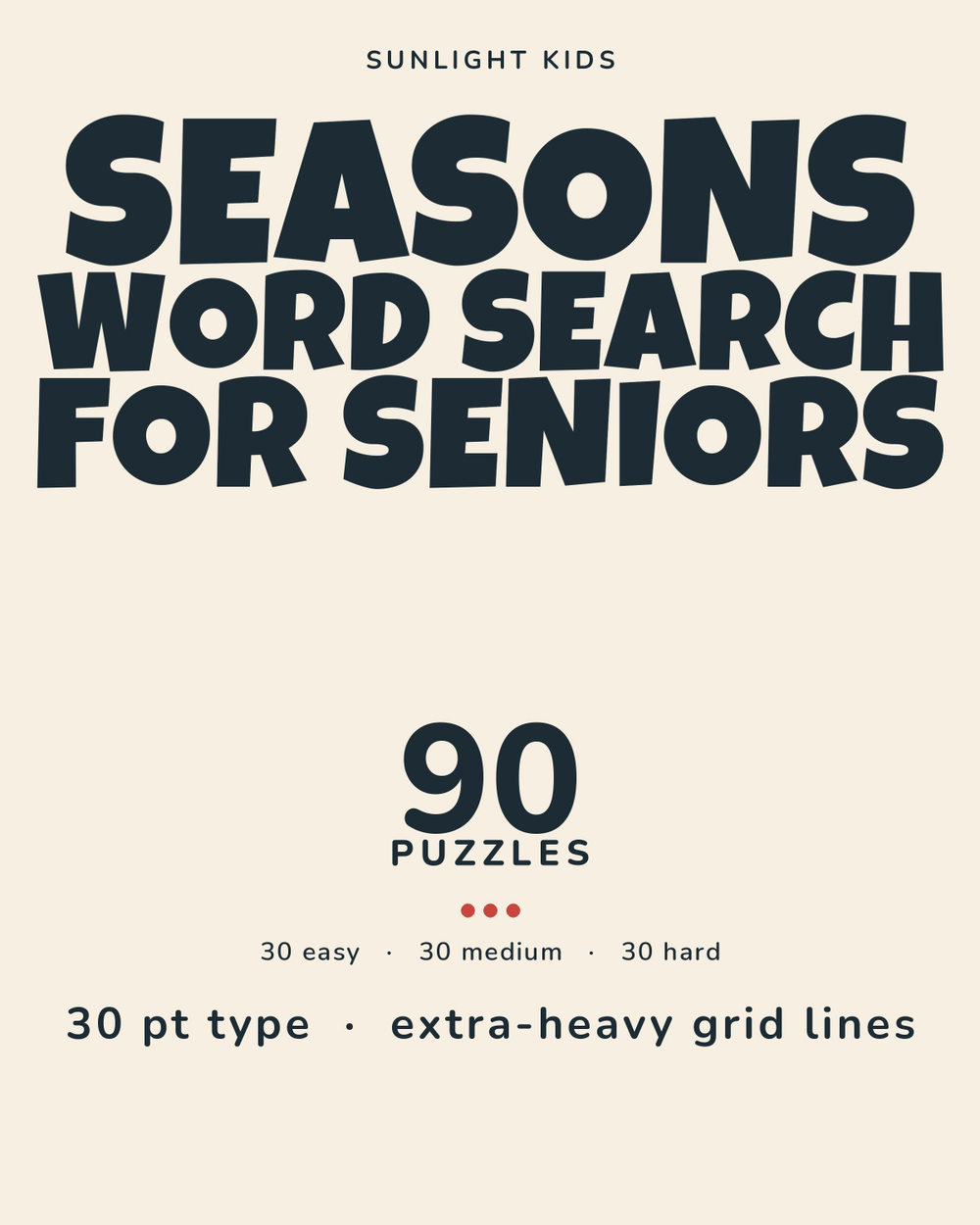
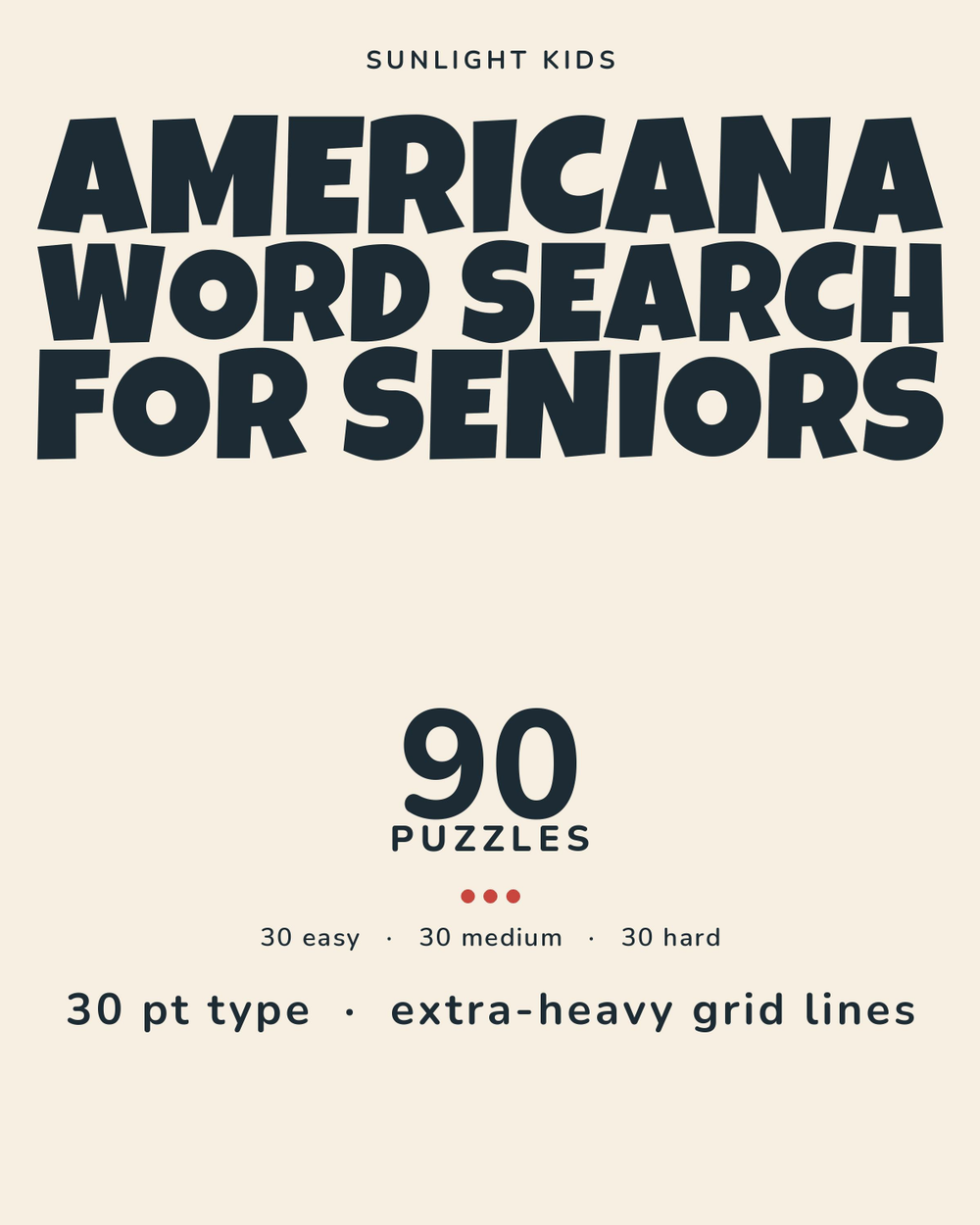
The large print edition. 90 puzzles across 119 pages at 8×10 inches, one puzzle per page, climbing from easy through medium to hard. The early puzzles run across and down; by the end words run in all eight directions and backwards. Fresh themed word list on every page, word bank in clear type beside every grid, no three-letter words, and every grid machine-checked so each word appears exactly once. Filler letters are drawn from the word list itself, so you can't shortcut a long answer by spotting an odd-looking cluster. Bright white paper with margins wide enough that it lies flat and takes pen without bleed-through. If you want one difficulty only, the same line splits into Easy, Medium, and Hard, with themed volumes for nature, travel, seasons, and Americana. Weakness: a strong solver will find the first third too easy — buy the Hard edition rather than the omnibus if you already solve 20×20 grids for fun. And this is the large print setting: bigger grids, fewer puzzles per volume.
Paperback$10.99In a rush? Download the PDF now and print it at home.
- #3
Penny Press and Dell word search magazines and compilations
AdultsBest value per puzzle, and the best pick for anywhere the book might not come home with you. Penny Press and Dell have been editing puzzle magazines for decades, the word lists are written for adults, and the compilation editions bundle enough puzzles to cover a long hospital stay or a month of commutes. Compact enough for a bag, cheap enough to leave in a seat pocket without regret. Weakness: paper quality is genuinely poor. Pencil smudges, ink bleeds through to the next puzzle, and the type is set small to maximize puzzle count. If your eyes are tired at the end of the day, this is the wrong book.
- #4
Brain Games large print word search
Adults · large printBest mass-market large print option and the easiest to actually find in a store. Publications International's Brain Games line prints big and consistently, keeps to one puzzle per page, and has enough volumes in print that you can buy the same format repeatedly — which matters more than it sounds when you've found a book that suits someone's eyesight. Weakness: large print here mostly means a bigger font in a smaller grid, so the puzzles get easier as they get more readable. Difficulty is flat across a volume and a competent solver will clear pages quickly. It is a comfort purchase, not a challenge purchase.
- #5
Puzzle Baron word search books
AdultsBest for solvers who care about the construction. The Puzzle Baron books come out of a puzzle-generation and testing operation rather than a general trade list, and it shows in the consistency: grids are dense, word lists are long, and the difficulty labeling means something across volumes instead of being cover copy. Weakness: production is utilitarian. Plain layouts, plain covers, and word lists that are often just categories rather than themes with any personality. It's a solver's book, not a gift book.
- #6
Mega-compilation word search books (300–1,000 puzzles)
AdultsBest price per puzzle if you solve daily and don't care what the puzzles are about. The giant compilations do exactly what they promise: months of grids in one spine for roughly what a hundred-puzzle book costs. For a committed daily solver working through one puzzle with morning coffee, the math is hard to argue with. Weakness: they hit those numbers by cutting corners you'll notice — small grids, small type, thin paper, word lists recycled across the volume, and binding that won't survive being opened flat to the middle. Many are assembled from generator output with no editor named anywhere on the book, which is also why the same puzzle sometimes shows up twice.
Adult word search books by level
Pick by how you like to solve. Easy is relaxing, straight-line words; Medium adds diagonals; Hard uses all eight directions and backwards words, which is what keeps an experienced solver busy.
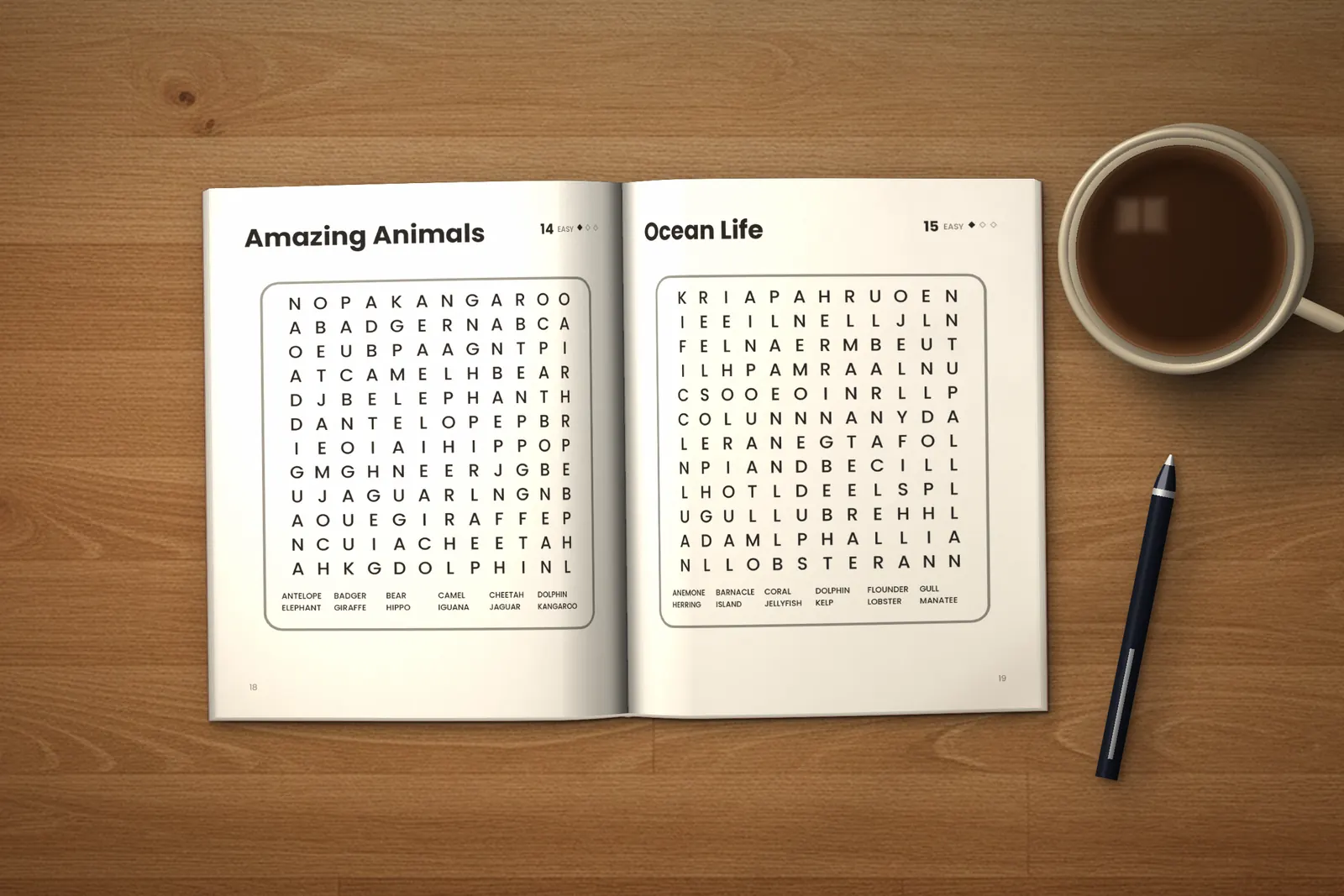
Word Search for Adults: Easy — 100 puzzles, one per page — across · down · diagonal
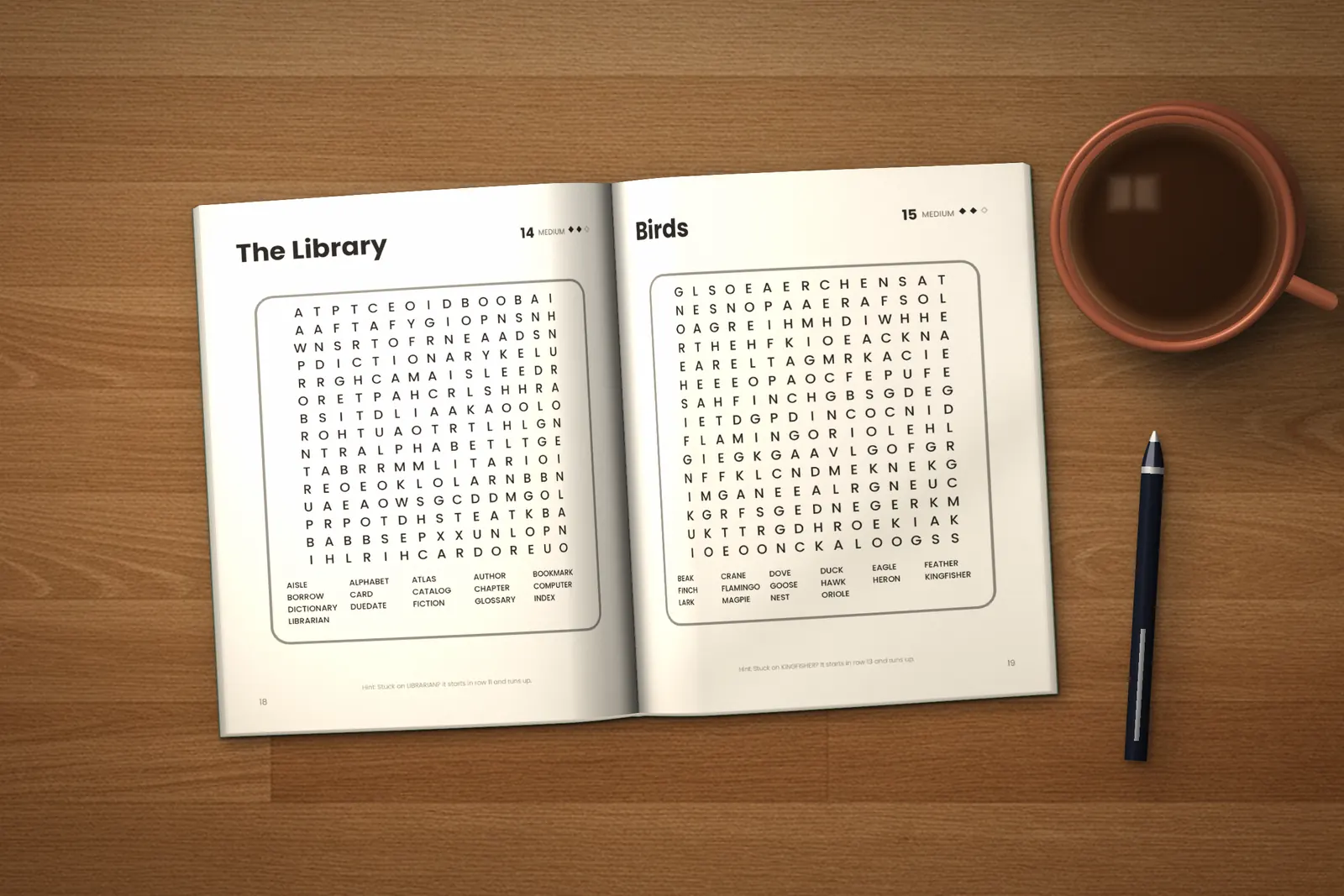
Word Search for Adults: Medium — 100 puzzles, one per page — 8 directions · backwards words
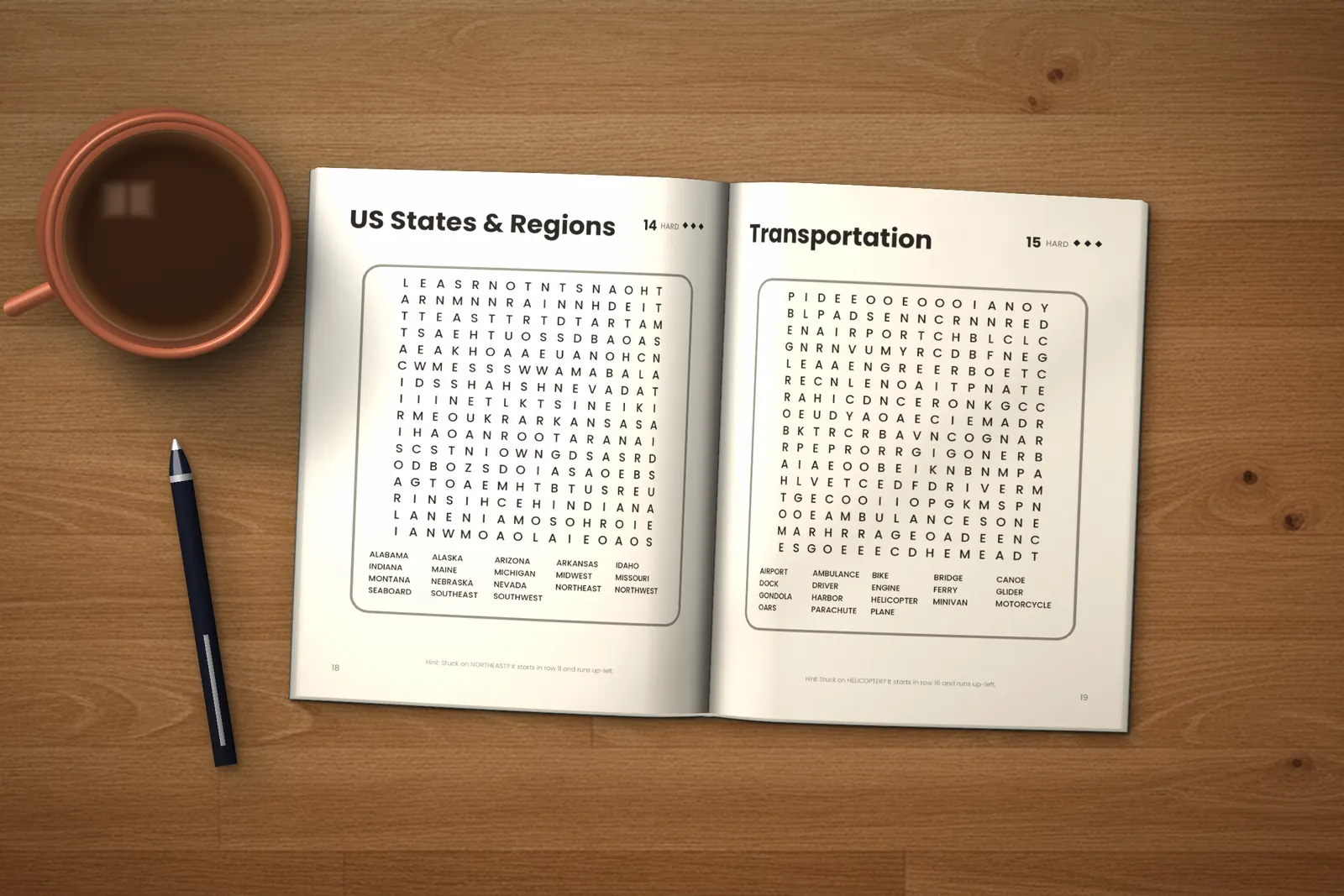
Hard Word Search for Adults — 100 puzzles, one per page — 8 directions · backwards words
Themed word search books for adults
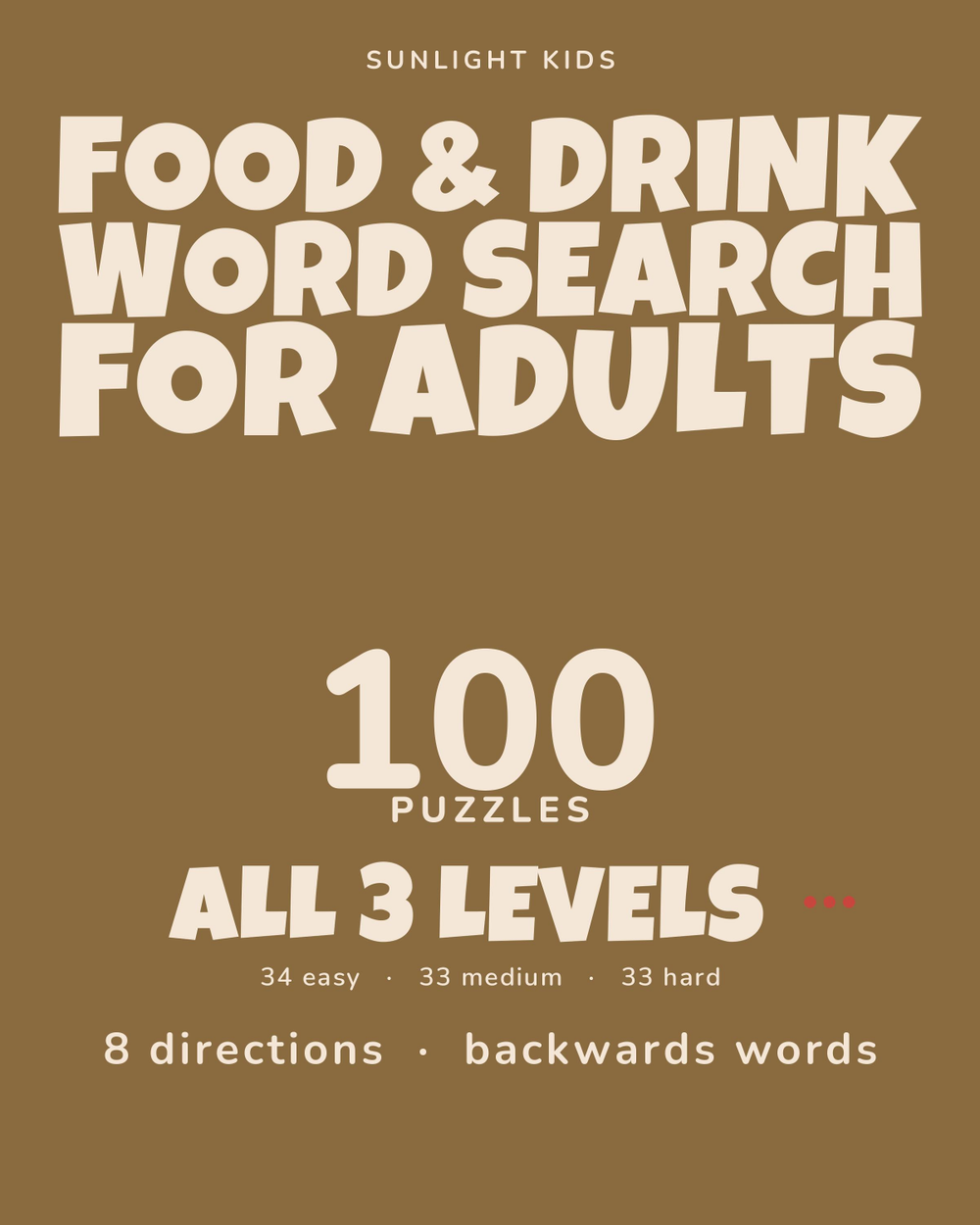
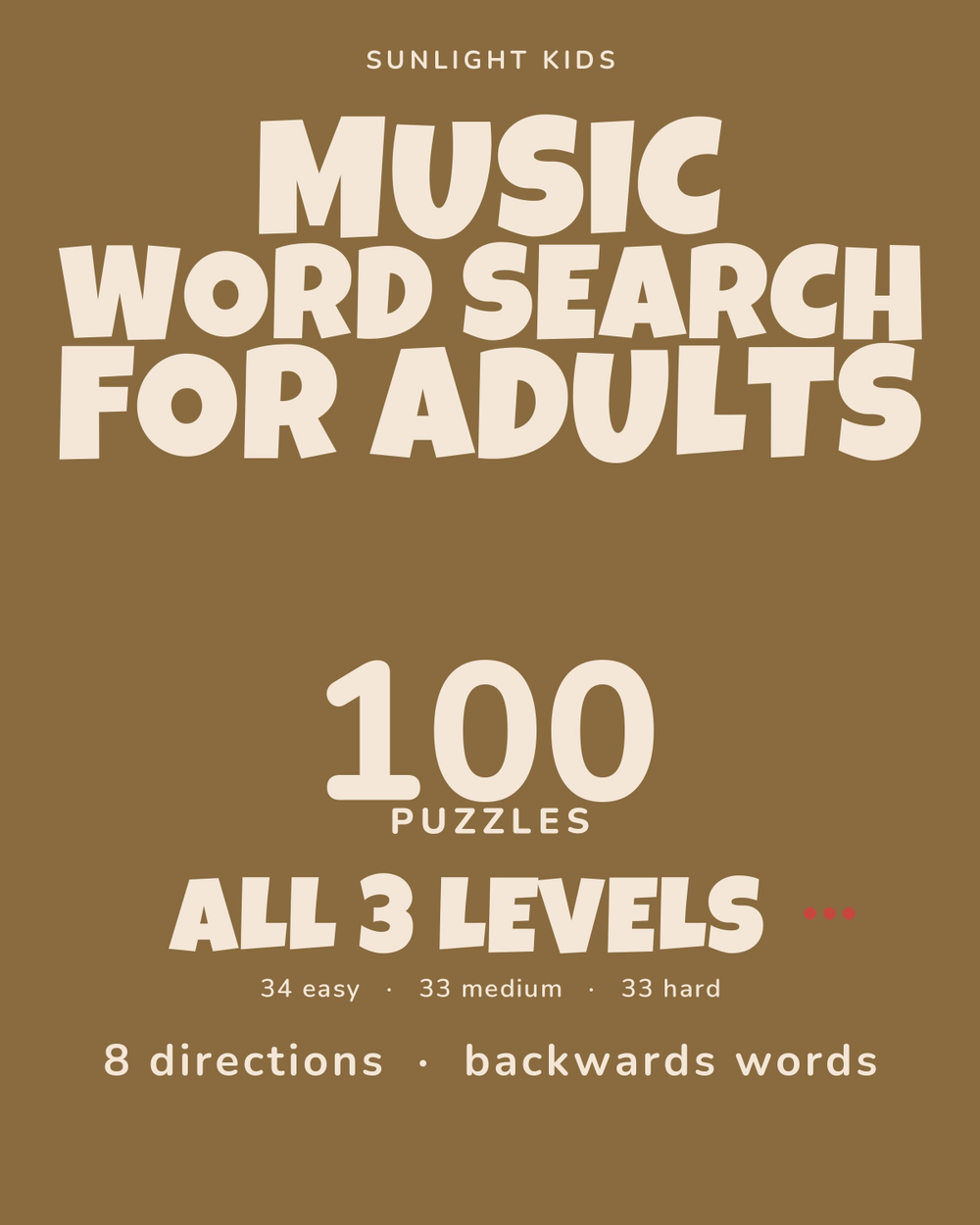
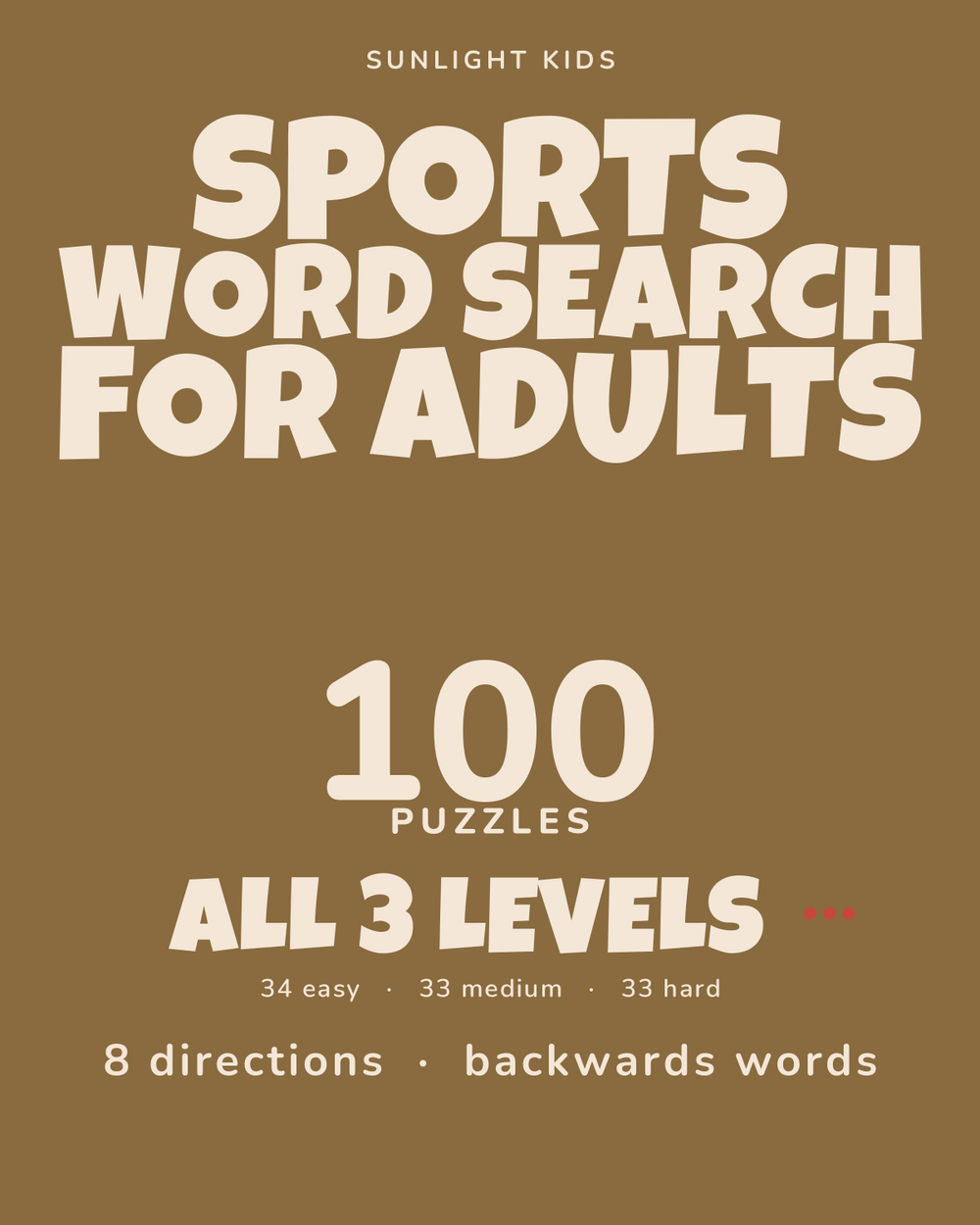
Themed volumes make the easiest gift: pick the subject they already care about. 100 puzzles each, easy to hard.
Large print word search
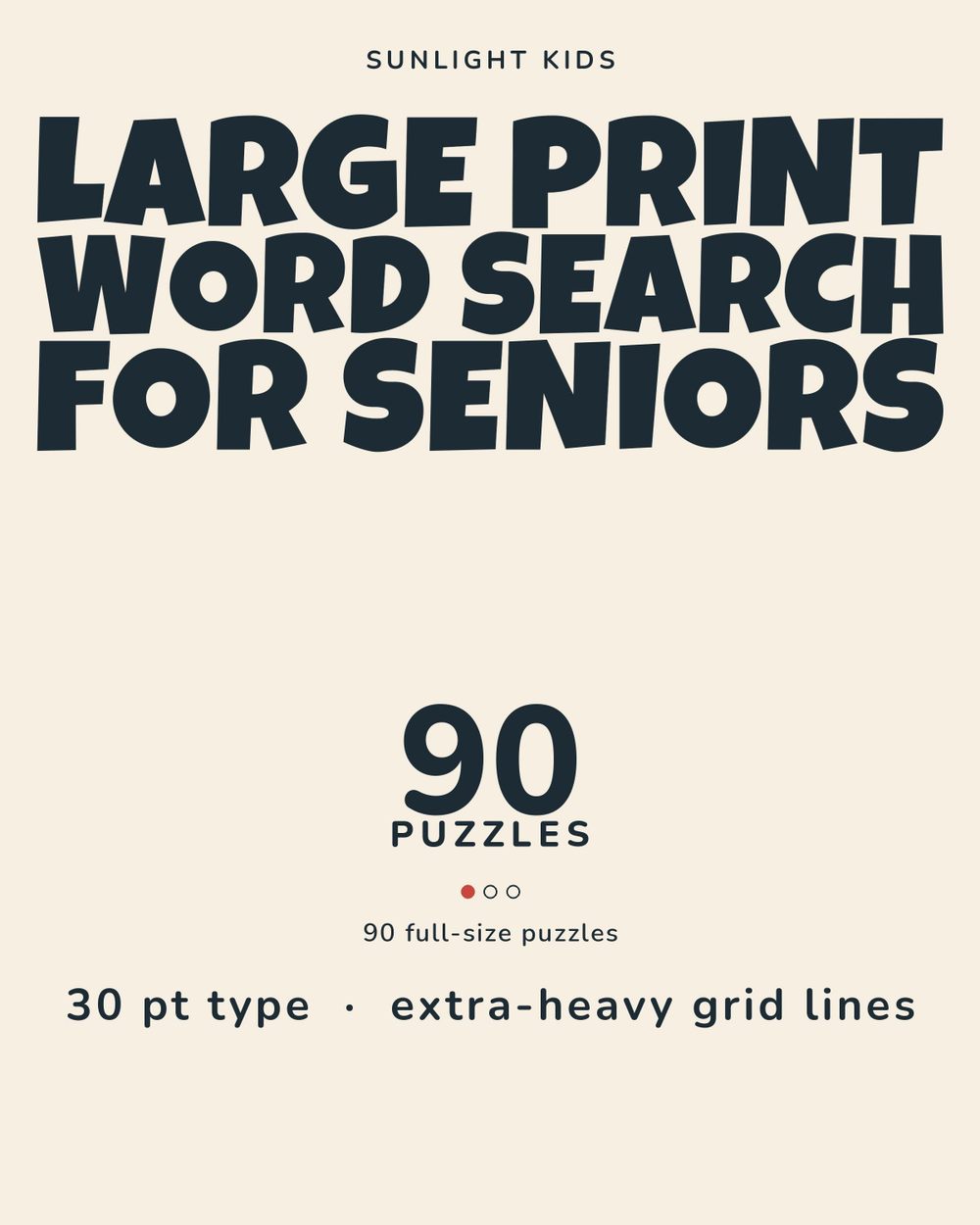
Bigger letters and grids, fewer puzzles per page — the right choice for reading at arm's length or under a lamp.
What to look for in a word search book for adults
Read the difficulty claim skeptically
"Expert" and "challenging" are unregulated words on a puzzle cover. The specs that matter are printed on the back or visible in the preview: grid dimensions, words per puzzle, and directions allowed. If a book won't tell you those three things, assume the easiest answer to each.
Themed word lists beat random ones
A puzzle about Italian cooking or Pacific coastline gives the brain something to hold onto and quietly refreshes vocabulary while you solve. Random-word grids are the same mechanical task with nothing on top. Themed volumes are also the better gift, because you can match the theme to the person.
Large print means spacing, not just font size
If you're buying for tired eyes or for someone older, look at the gap between letters, not the letter height. A big font packed into the same grid is harder to scan, not easier. The right large print book has fewer letters on the page overall — which usually means a smaller grid, and that's an acceptable trade.
Binding that lies flat
You solve a word search with the book open and one hand on the page. Tight perfect-binding on a thick compilation springs shut and forces you to flatten the spine, which cracks it. A larger trim size with fewer pages beats a brick, especially for solving in a chair, on a tray table, or in bed.
DIY vs buy
Word search is the one puzzle category where printing genuinely competes with buying, because the puzzle is entirely in the grid — a well-constructed 22×22 grid is just as hard off a home printer as off a press. Our free difficult word search pack (/printables/difficult-word-search) is ten 22×22 grids with 30+ words each, adult themes, heavy overlap between answers, and 30–60 minutes of work per puzzle. The hard word search pack (/printables/hard-word-search) is ten 20×20 grids with 25+ words, a step down and a good place to calibrate. Print a couple, see which density suits you, and you've spent nothing finding out. Buying wins on three things printing can't match: volume without a printer, a book that survives a suitcase and a year in a car door, and — for large print especially — paper and type quality you can rely on page after page. Most regular solvers end up with both: a PDF for the unplanned evening and a book that lives in the bag.
The word search books we publish
Ages 2–5 · 4–7 · 7+ · Adults
Frequently asked questions
- What actually makes a word search hard?
- Four things, roughly in order of impact. Grid density — a 20×20 grid has nearly twice the search area of a 15×15. Word count and word length, since long words are easier to spot than short ones, so hard puzzles use many medium-length words. Direction rules, where diagonals and reversals each roughly double solve time. And filler letters: if the letters around the answers are drawn from the same word list, you can't identify a hidden word by the shape of an odd letter cluster, which is how most people unknowingly speed-solve easy puzzles.
- Are word searches good for the brain?
- They're real cognitive activity — sustained attention, visual scanning, and working memory — but be careful with the claims on the covers. The research on puzzles and cognitive health points to variety and novelty as the active ingredients, not any single format. Doing the same difficulty of word search every day for years mostly makes you better at word searches. Mixing in crosswords, sudoku, or anything you find genuinely harder is the better use of the same half hour.
- What's the best word search book for seniors?
- A large print edition with real letter spacing, one puzzle per page, and grids no larger than about 15×15. The mistake people make when buying for a parent or grandparent is choosing the biggest puzzle count, which always means the smallest type. Also check the binding: a thick compilation that won't stay open is genuinely difficult to use with arthritic hands, and a slimmer book with a larger trim size is worth more than twice the puzzles.
- Pen or pencil?
- Pencil, unless the book explicitly uses thick bright white stock. Most word search books are printed on paper thin enough that a ballpoint or gel pen ghosts through onto the reverse page, and on newsstand magazine stock it bleeds outright. Highlighters are worse. If you like pen for the satisfaction of a permanent line, buy the book on the better paper and treat it as part of what you're paying for.
- How many puzzles should an adult word search book have?
- Around 100 is the sweet spot for a book you want to enjoy; 300 and up is a volume purchase with predictable trade-offs in grid size, type size, and paper. A useful rule: if the puzzle count is high and no editor or constructor is named anywhere on the book, it's generator output that nobody checked, which is where duplicate answers and unsolvable keys come from.
- Are themed word search books worth it?
- Yes, for two reasons. The word lists give you something to think about beyond the mechanical search, which is what stops the format going stale after fifty puzzles. And they're the far better gift — a nature or travel or music volume tells the person you thought about them, where a generic book says you bought a puzzle book. The catch is that theming constrains the constructor, so themed volumes sometimes lean on obscure terms to fill a list.
Sunlight Kids activity books — for every age.
Ages 2–5 · 4–7 · 7+ · Adults