Best Sudoku Books for Kids (2026 Guide by Age and Grid Size)
Sudoku is the rare puzzle a six-year-old and a sixty-year-old play by exactly the same rule, and the rule takes thirty seconds to explain: no repeats in a row, a column, or a box. What changes with age isn't the rule — it's the grid. The most common way a sudoku book for kids fails is that a parent buys a 9×9 book labeled "easy," the kid stalls on page one, and everyone concludes they aren't ready for sudoku. Usually the kid was ready and the grid was wrong. So this guide sorts by grid size first and difficulty label second. Note on this site: we publish sudoku books for kids ourselves, and ours is in the list below, flagged as ours. Read it with the skepticism that deserves. Everything else here is what we'd buy as parents, and every pick — including ours — is listed with the thing it does badly.
The short answer
- 1.Sunlight Kids — Sudoku for Kids: Easy, Medium & HardAges 6–12
- 2.Large-print beginner sudoku books with 4×4 and 6×6 gridsAges 5–7
- 3.Standard large-print 9×9 sudoku compilationsAges 10+
- 4.Highlights puzzle books (Puzzlemania, Hidden Pictures)Ages 6–10
- 5.Teacher-supply logic workbooks (Evan-Moor, Carson Dellosa, Scholastic)Ages 7–11
Free printable starter pack
17 pages · Shapes 4–6 · 4×4 ages 5–7 · 6×6 ages 7–10
How we chose
Grid size progression, not just difficulty
4×4 (four 2×2 boxes, digits 1–4) is the real entry point — a child can hold the whole grid in their head at once. 6×6 is the bridge, and it's a bigger conceptual jump than it looks because the boxes stop being square. 9×9 is the actual game. A book that opens at 9×9 has only one dial to turn: how many digits it gives you. We favored books that climb through all three.
Does it teach the logic, or just supply grids?
Generating a thousand valid sudoku grids takes a laptop about a second, which is why most sudoku books for kids are grids plus a one-paragraph rules page. Look for a worked example and named techniques a kid can actually apply — scan a row for what's missing, find the square with only one option left, pencil in the maybes. That's the difference between a book that builds a solver and a book that entertains one.
One puzzle per page
Four grids crammed onto a page means small squares, and small squares mean no room for pencil marks — which is the single most useful habit a kid can learn. Children also write large and erase badly. One puzzle per page on a large trim size costs more paper and is worth it.
Answer keys, and puzzles with exactly one answer
Every puzzle needs a checkable answer in the back, laid out so checking puzzle 12 doesn't spoil puzzle 13. Just as important: a properly built sudoku has exactly one solution and can always be finished by reasoning. Cheap generators sometimes ship grids with multiple solutions, which teaches a kid to guess — the opposite of the point.
Our top picks by age and grid size
- #1
Sunlight Kids — Sudoku for Kids: Easy, Medium & Hard
Ages 6–12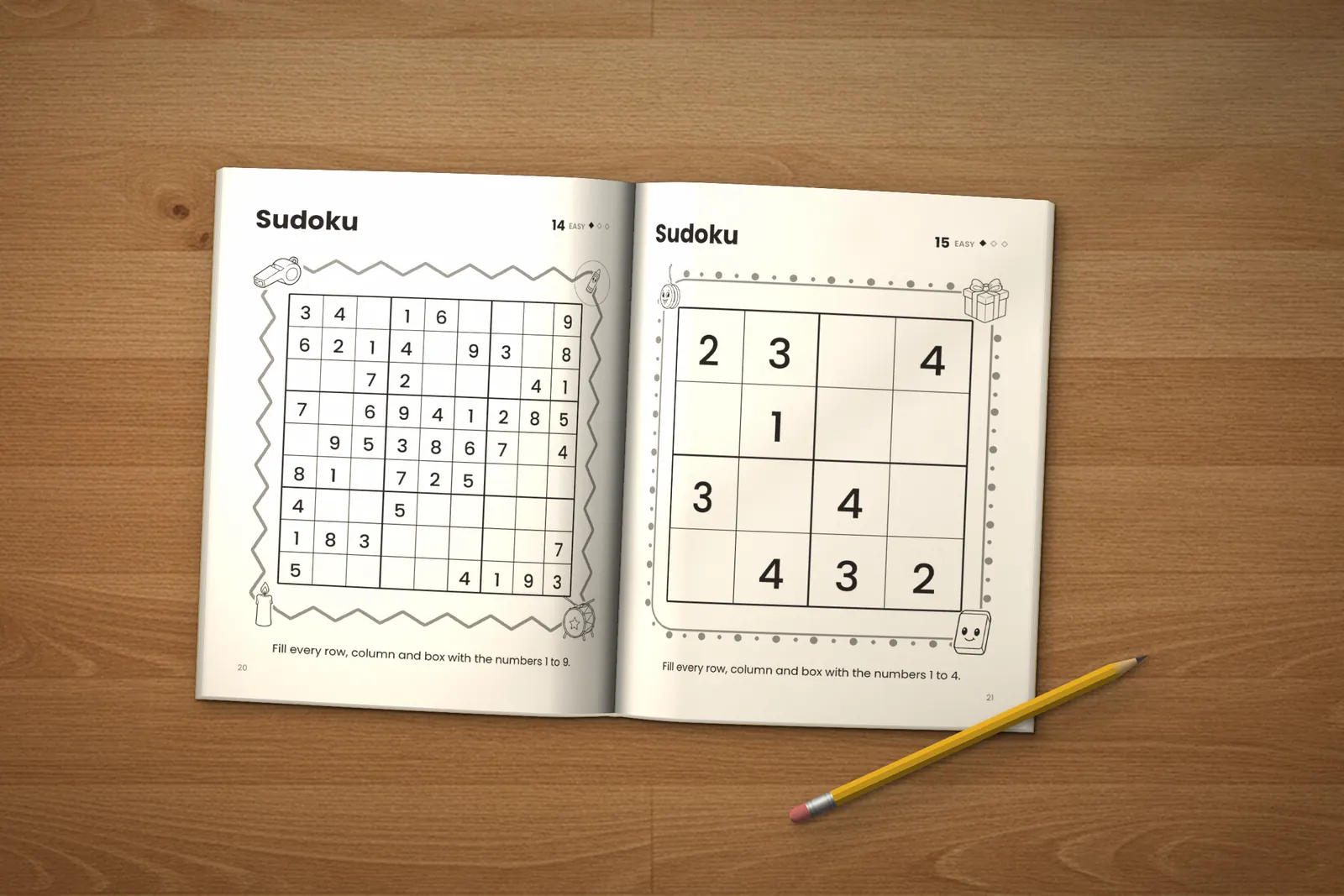
Best for a house with more than one age in it, or a kid you expect to outgrow the easy band fast. 100 puzzles across all three levels — 34 easy, 33 medium, 33 hard — one per page, starting at 4×4 and 6×6 before the full 9×9 grid. There's a teaching page up front with a worked example, and the solving tips are written for a child rather than paraphrased from an adult book. Every grid is computer-checked for exactly one solution, so no puzzle dead-ends into a guess. Full answer key in the back. Weakness: if you already know your kid's level, the single-band editions are the better buy: Easy (ages 6–9), Medium (8–11) and Hard (9–12) each give you 100 puzzles at that level instead of 33.
Paperback$10.99In a rush? Download the PDF now and print it at home.
- #2
Large-print beginner sudoku books with 4×4 and 6×6 grids
Ages 5–7Best for a genuine first sudoku book, before a kid has any business looking at a 9×9 grid. This is a well-stocked category — search on grid size rather than a brand, because the useful signal is on the cover: the words "4x4" and "6x6" and a sample grid you can see in the preview image. A five- or six-year-old who can count to four and understands "one of each" can finish these. Weakness: nearly all of them are software output with a rules paragraph and nothing else, several print four grids to a page, and the difficulty label is frequently decorative. Check the interior preview before buying — if the sample page shows four tiny grids, skip it.
- #3
Standard large-print 9×9 sudoku compilations
Ages 10+Best for the kid who has outgrown books aimed at children and wants the real grid. Once a ten- or eleven-year-old is finishing 9×9 puzzles reliably, an ordinary large-print adult compilation gives them hundreds of puzzles instead of dozens, and the large-print editions have grids big enough to pencil-mark. Weakness: no teaching whatsoever, and "easy" in an adult book usually means easy for an adult who already solves — it can sit well above a competent ten-year-old. Avoid pocket editions entirely; the grids are too small for a child's handwriting.
- #4
Highlights puzzle books (Puzzlemania, Hidden Pictures)
Ages 6–10Best for the kid who won't sit still for pure logic. Highlights mixes sudoku in among hidden pictures, word puzzles and drawing pages, so a child who bounces off a book of nothing but grids will still do three sudoku on the way past. Consistently kid-tested art direction and reliable print quality. Weakness: sudoku is a small slice of the mix — a handful of grids per issue. It's a taster, not a way to build the skill, and there's no grid-size progression at all.
- #5
Teacher-supply logic workbooks (Evan-Moor, Carson Dellosa, Scholastic)
Ages 7–11Best for classroom or homeschool use, where you want sudoku sitting inside a broader thinking-skills sequence with lesson-shaped pacing. These publishers write to grade level rather than to a vague age band, which is genuinely more accurate, and the teacher notes tell you what skill each page is supposed to build. Weakness: they're designed to be photocopied, so they read like worksheets — small grids, often several per page, and thin paper that tears under an eraser. Sudoku is usually one unit inside a bigger book rather than the point of it.
Easy sudoku books for kids (ages 6–9)
Start with grids where most of the numbers are already filled in, so the logic is visible. Sudoku for Kids: Easy is 100 puzzles at that level, with a step-by-step how-to at the front.
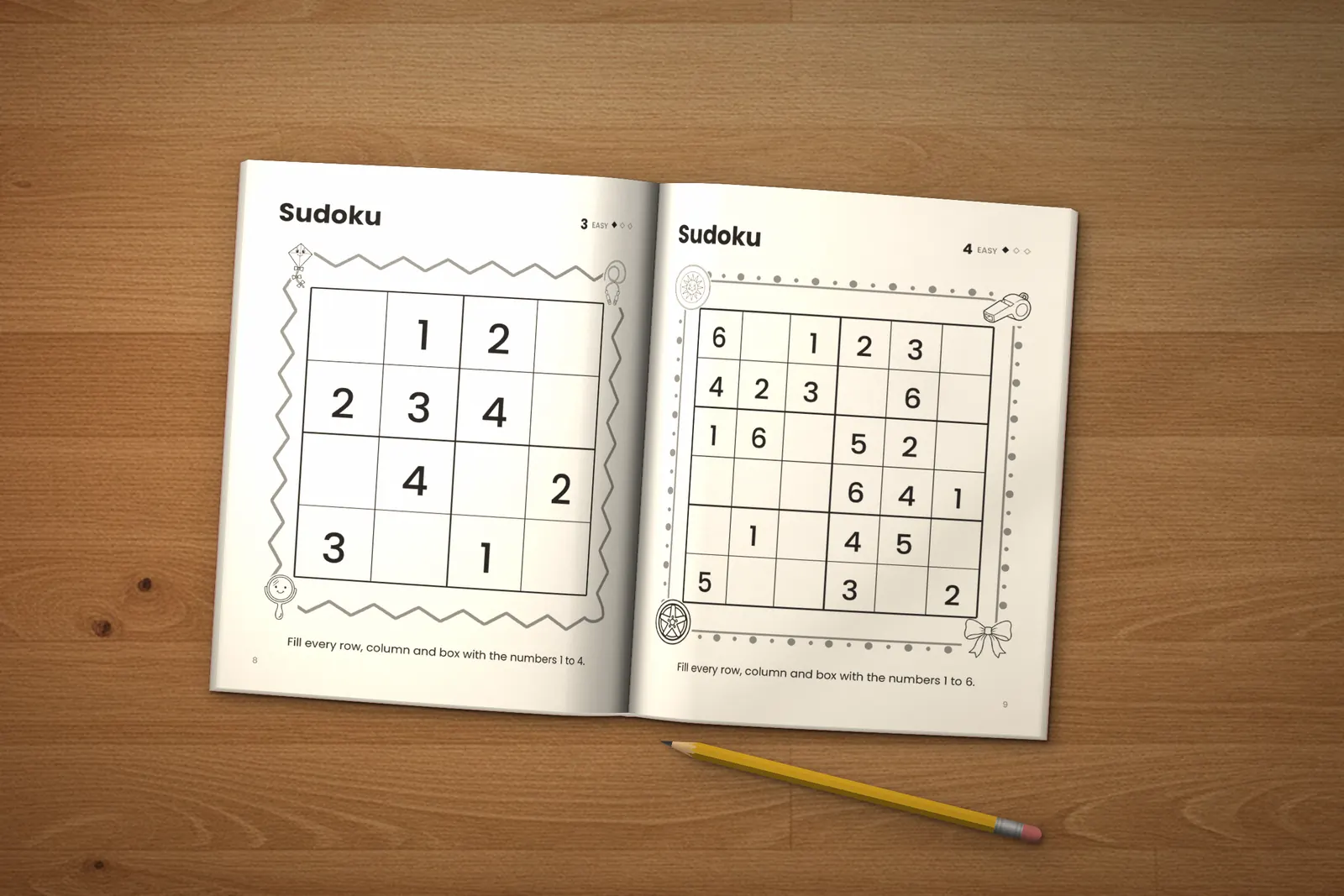
Sudoku for Kids: Easy — 100 puzzles, one per page — 4x4 · 6x6 · 9x9 grids
Medium and hard sudoku for kids (ages 8–12)
Once a child finishes easy grids without help, move up a level. Medium removes more givens; Hard (ages 9–12) needs real chains of reasoning — the bridge to adult sudoku.
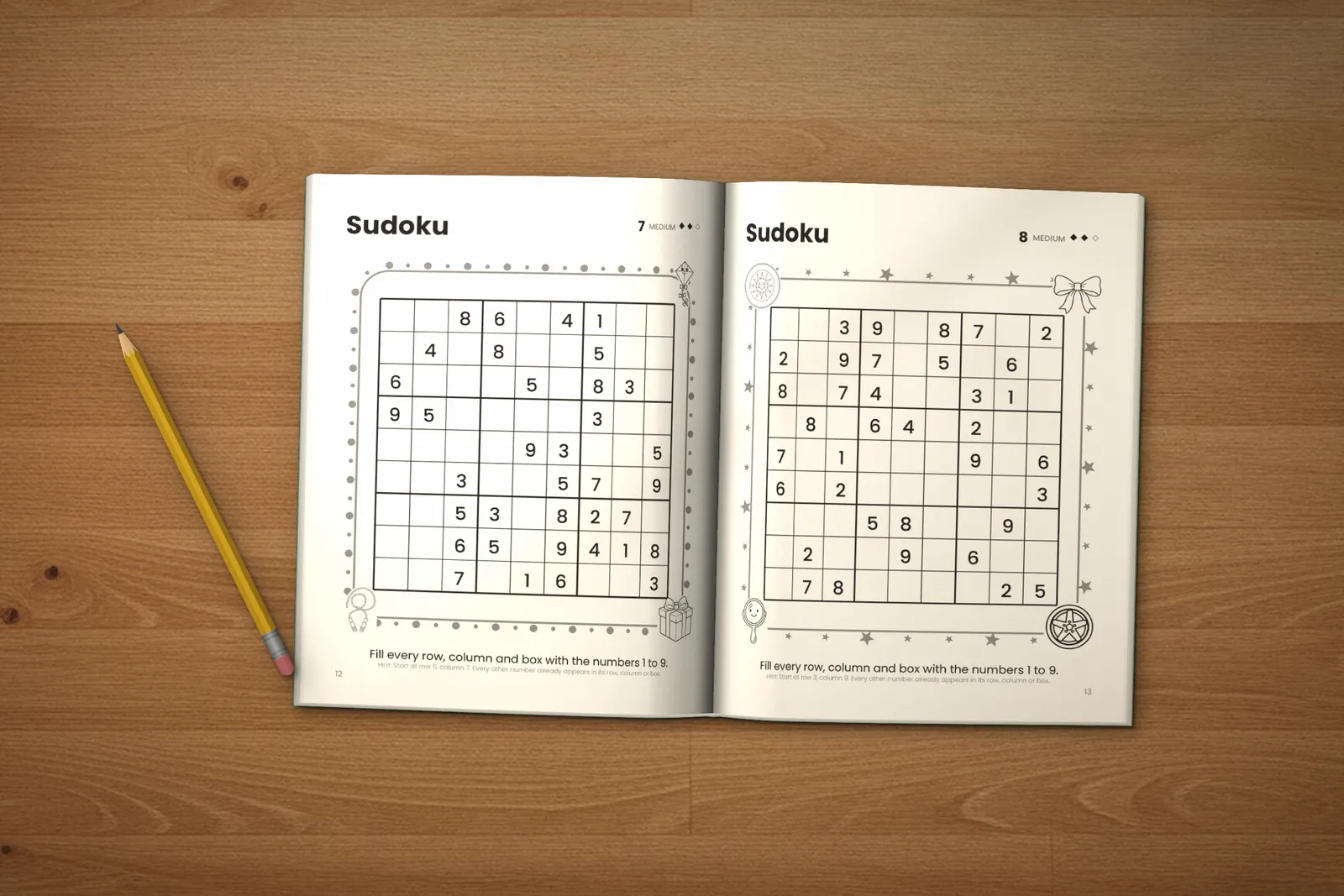
Sudoku for Kids: Medium — 100 puzzles, one per page — full-size 9x9 grids
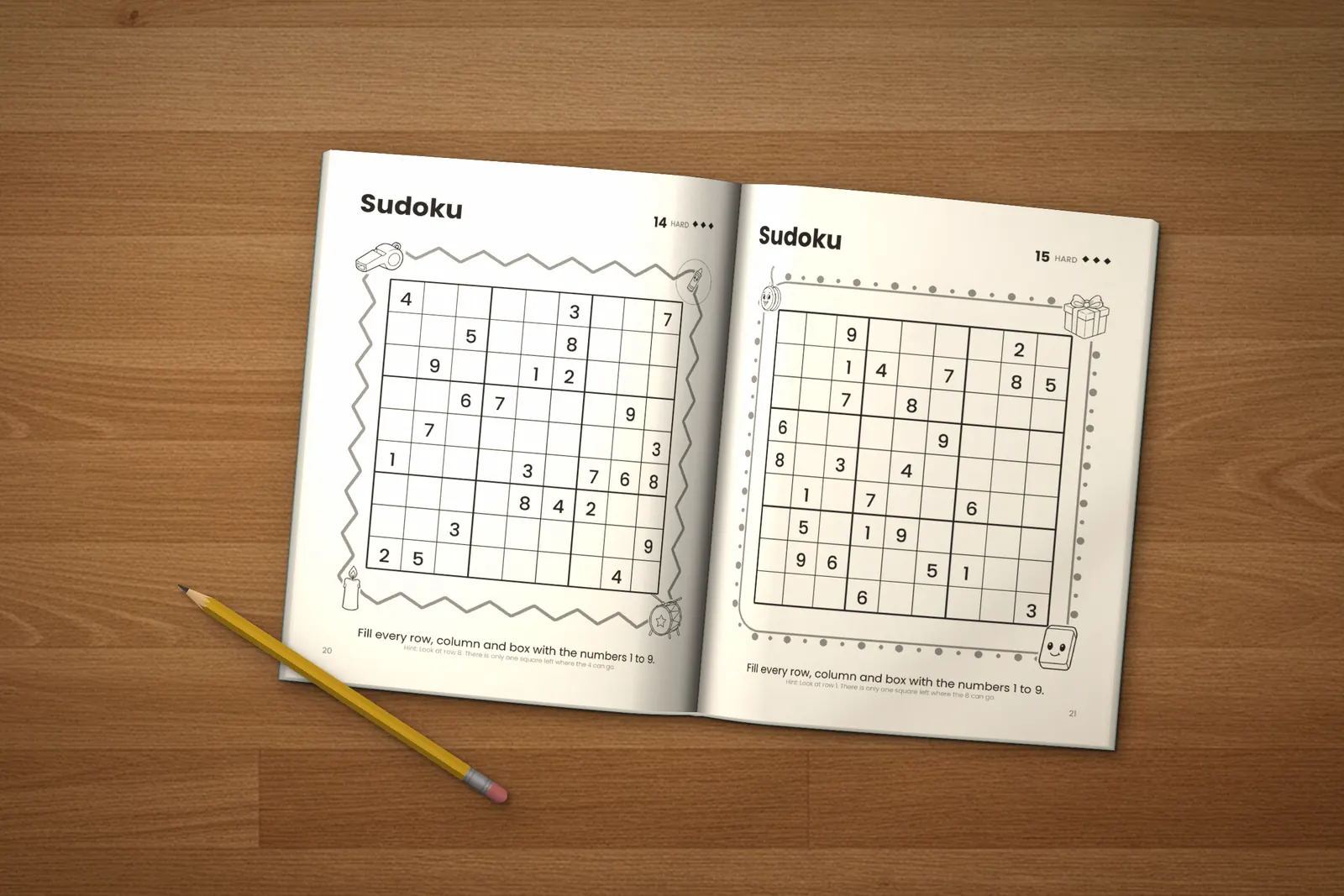
Sudoku for Kids: Hard — 100 puzzles, one per page — full-size 9x9 grids
Sudoku for Kids: Easy, Medium & Hard — 100 puzzles, one per page — 4x4 · 6x6 · 9x9 grids
Sudoku for teens
Past twelve, kids books start to feel babyish even when the puzzles are hard. The teens line is the same 9×9 sudoku with an older look and a steeper top end.
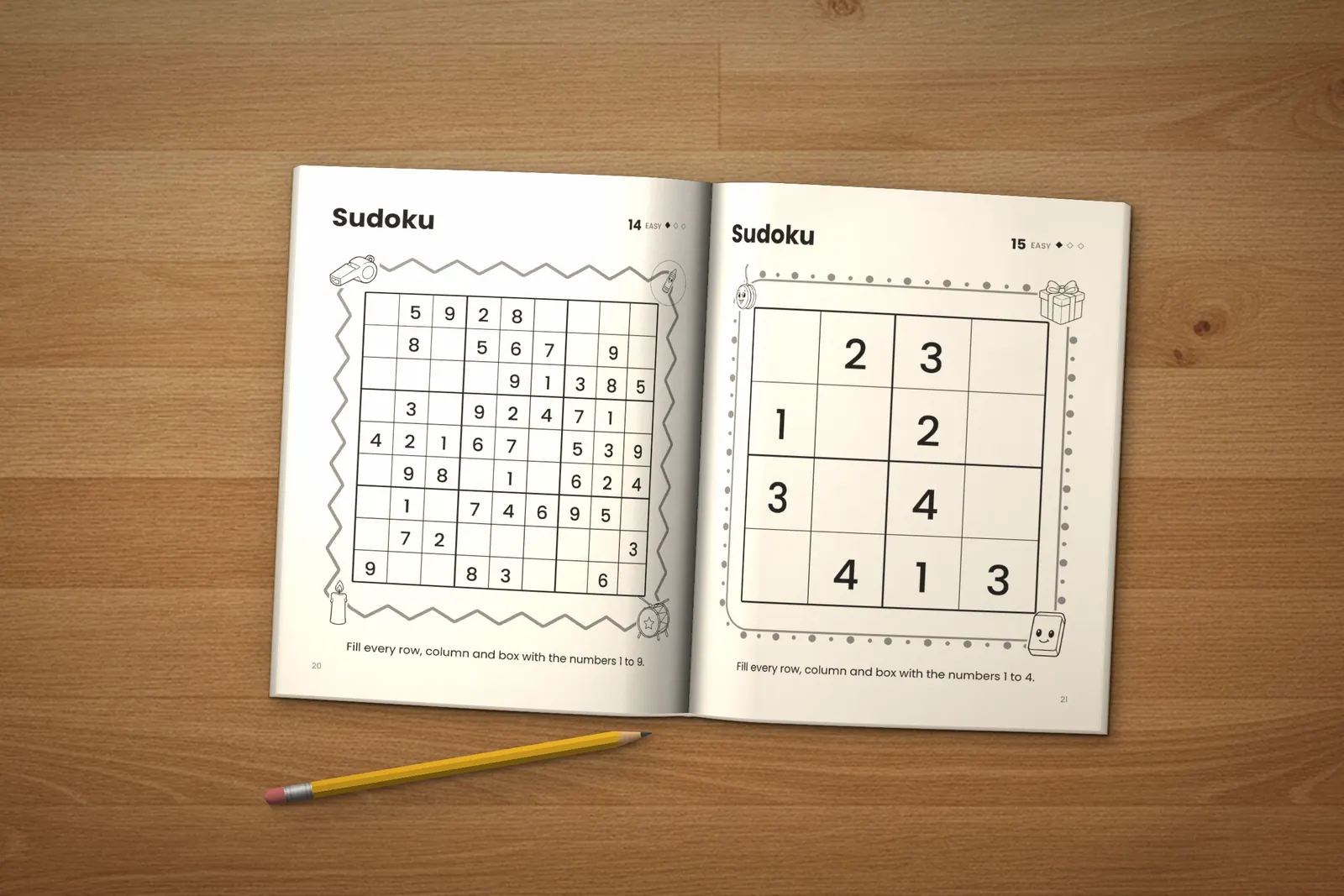
Sudoku for Teens: Easy, Medium & Hard — 100 puzzles, one per page — 4x4 · 6x6 · 9x9 grids
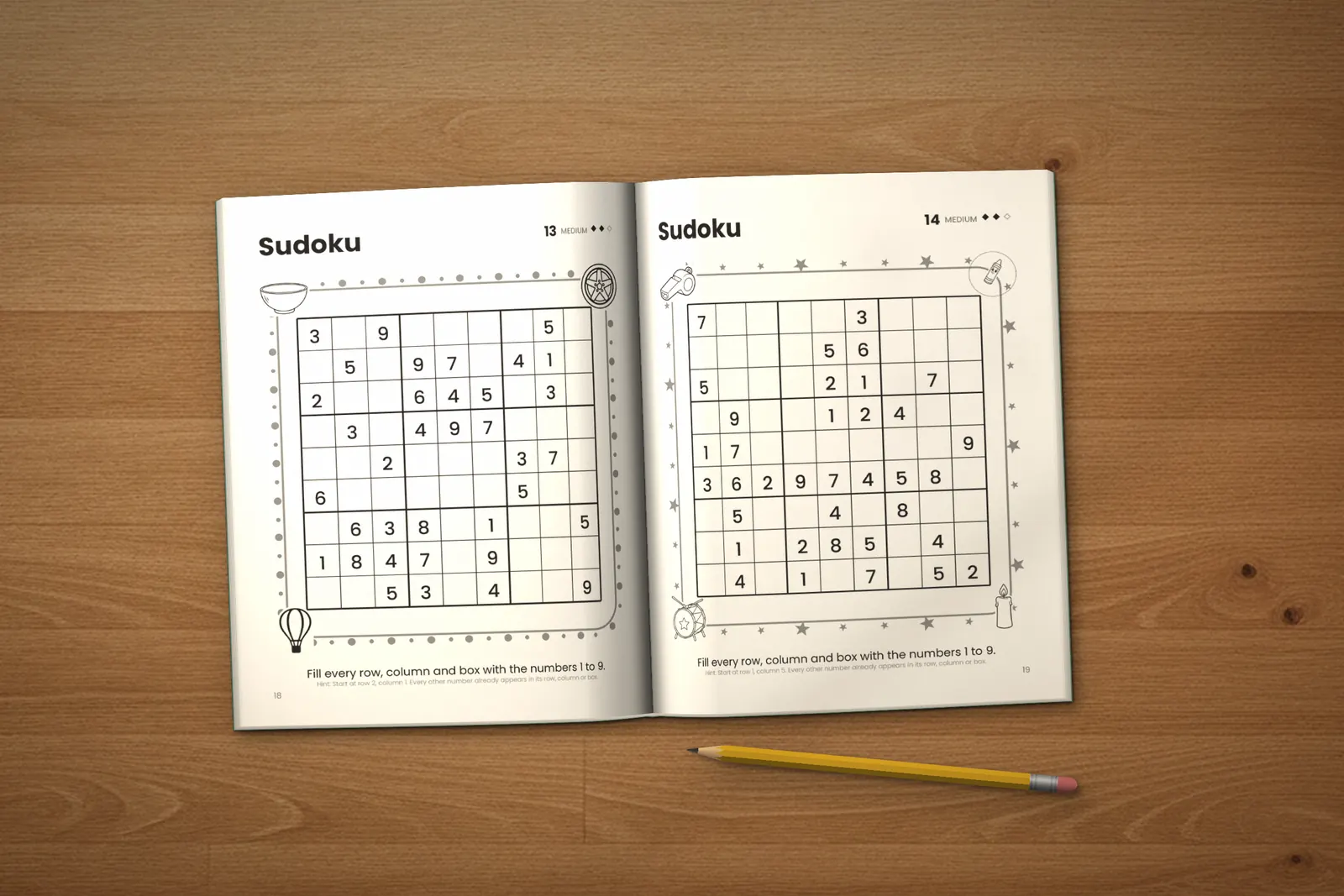
Sudoku for Teens: Medium — 100 puzzles, one per page — full-size 9x9 grids
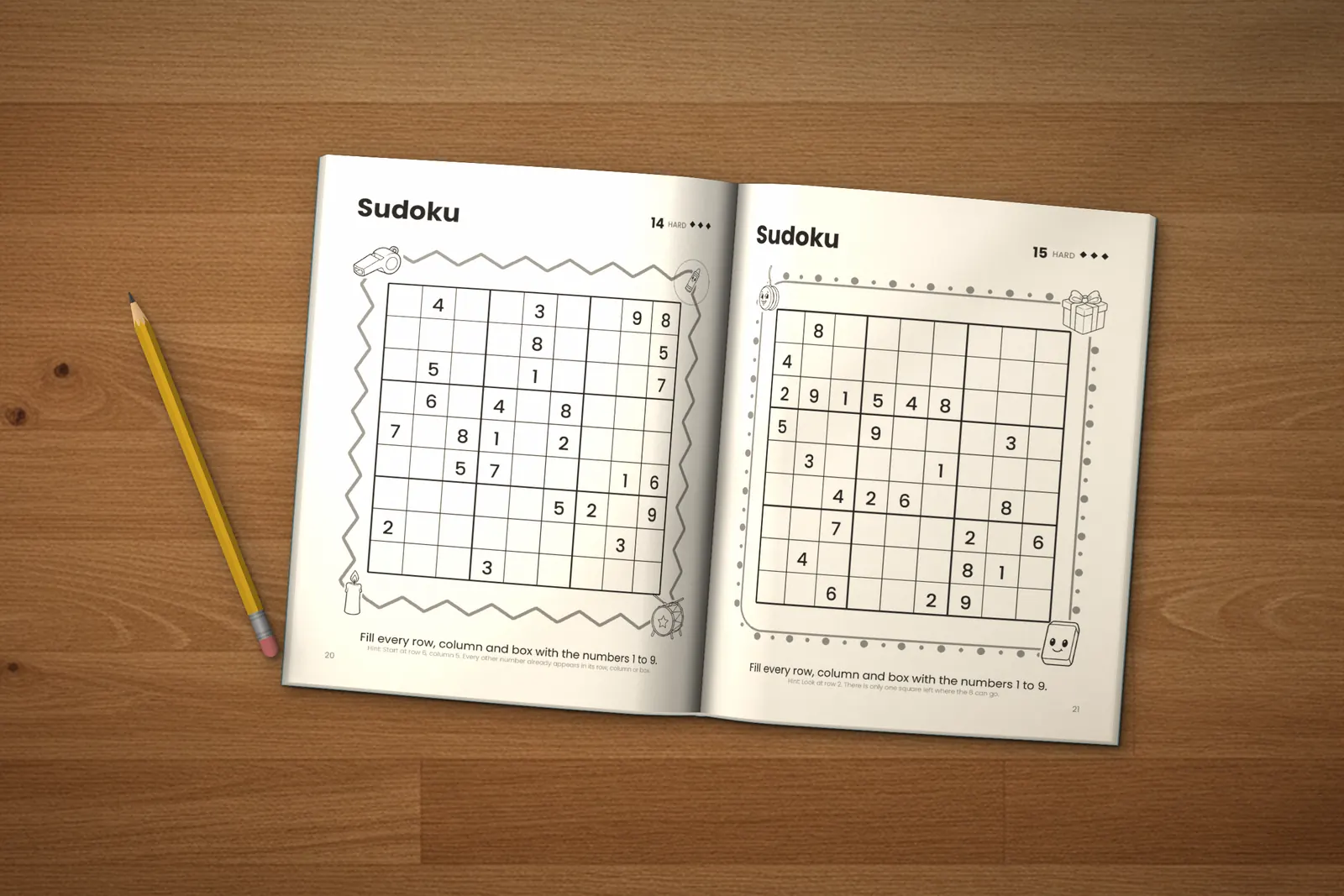
Sudoku for Teens: Hard — 100 puzzles, one per page — full-size 9x9 grids
What to look for in a sudoku book for kids
Digits, not pictures, once they can count
Some 4×4 books for pre-readers use animals or shapes instead of numbers. That's fine at four or five, but it costs a small re-learn later, because the child has to redo the rule in a new alphabet. If your kid knows 1–4 confidently, start with digits.
Check the grid lines, not just the print size
The box borders need to be visibly heavier than the cell lines. Faint box borders are the number one reason a child breaks the box rule and then can't work out why the puzzle won't close. Zoom the interior preview image and look at the lines before you look at anything else.
Paper that survives an eraser
Kids solve sudoku in pencil and erase constantly. Thin, greyish paper pills and tears on the second erase, and pencil marks written in a 4-point corner space are unreadable anyway. Bright white stock and a large trim size do more for the experience than the puzzle count does.
Buy one level below where you think they are
Finishing puzzle one is the entire reason puzzle two happens. A kid who completes an easy book cover to cover will ask for the next level; a kid stopped cold on page three concludes sudoku isn't for them, and that verdict tends to stick for a couple of years. Under-buy on difficulty, deliberately.
DIY vs buy
Free is a completely reasonable way to find out whether your kid likes sudoku at all — start with our free printable sudoku pack at /printables/sudoku-for-kids, print a few, and see if they ask for more. Online generators will also hand you unlimited valid grids for nothing. What free doesn't give you is sequence. A generator produces puzzles at whatever difficulty you asked for, in no order, with no teaching and no reason for a child to keep going after the novelty passes. A well-built book is a curriculum: it starts at 4×4, moves to 6×6 when the rule is secure, opens up the 9×9 grid, and teaches one technique at a time along the way. Print the free pack first. Buy the book once you know it stuck.
The sudoku books for kids we wrote ourselves
Ages 2–5 · 4–7 · 7+ · Adults
Frequently asked questions
- What age can a child start sudoku?
- Most kids can do a 4×4 sudoku somewhere between five and six and a half, and some capable four-year-olds manage it with an adult sitting next to them. The prerequisite isn't math — it's being able to hold a rule in mind while scanning, plus recognizing the digits 1–4. Six-by-six usually lands around seven, and the full 9×9 grid is comfortable for most kids somewhere between eight and ten.
- 4×4 or 6×6 for a 6 year old?
- 4×4, almost always. Six-by-six looks like a small step up and isn't: the boxes become 2×3 rectangles, so a child has to stop thinking "square" and start reading the heavy border to know where a box ends. That's a real conceptual jump, and it's much easier to make it once the 1-of-each rule is automatic. Give a six-year-old a book of 4×4 puzzles they can finish, and they'll be asking for 6×6 within a few weeks.
- Does sudoku actually help with math?
- Not with arithmetic, and it's worth being straight about that — the digits in a sudoku are only symbols, and you could replace them with letters or colors without changing the puzzle at all. What sudoku genuinely exercises is deductive reasoning, working memory, systematic search and self-checking: hold constraints in mind, eliminate options, notice your own mistake and back out of it. Those are real and worth having. Evidence that puzzle practice transfers to unrelated school performance is weak, so buy sudoku because it's an absorbing screen-free hour, not as a maths intervention.
- How many puzzles should a kid do in one sitting?
- One to three, and stop while they still want another. Sudoku rewards sustained concentration, and a child who pushes past the point of tiredness starts guessing — which builds exactly the wrong habit. Ten focused minutes a few times a week beats an hour once.
- Should I let them guess when they get stuck?
- No, and a good book makes it unnecessary: a properly built puzzle has exactly one solution and can always be reasoned to the end. When a kid stalls, the fix is almost always a technique rather than a guess — pencil the possible digits into each empty square in a row, then look for a square with only one candidate left. If a puzzle genuinely can't be finished without guessing, the puzzle is broken, not the child.
- Can I buy the Sunlight Kids sudoku books?
- Yes — Sudoku for Kids is on Amazon in Easy (ages 6–9), Medium (8–11), Hard (9–12) and a combined Easy, Medium & Hard edition. If you want to try the format first, the free printable sudoku pack at /printables/sudoku-for-kids costs nothing.
Sunlight Kids activity books — for every age.
Ages 2–5 · 4–7 · 7+ · Adults