Best Travel Activity Books for Kids (2026 Buyer's Guide)
A travel activity book is judged on a tray table, in a middle seat, forty minutes into a delay, by a four-year-old who is done. That is a much narrower test than "is this a good activity book," and most books that pass the second test fail the first. The ones that fail do it for boring, physical reasons: the book is too wide for the tray, the spine will not stay open so a small hand cannot hold it and colour at the same time, it came with 200 stickers that are now under seat 14C, or every page needs a grown-up to explain it and the grown-up is holding a baby. So this guide is organised around the constraints rather than the content. What fits. What stays open. What needs nothing but a pencil. What a child can do without you turning around. We have done a lot of long flights with small children and lost a lot of crayons in the gap beside the seat, and the picks below reflect that more than they reflect any listing copy. Full disclosure: we publish travel activity books ourselves — a line of destination books built for exactly this use — and they appear as our first pick. We have marked them clearly and named their drawbacks alongside everyone else's.
How we chose
It has to fit the tray table and the seat pocket
An economy tray is roughly 10 by 15 inches and half of it is holding a drink. A standard 8 by 10 activity book fits with room to work; anything wider than about 11 inches hangs off an edge and slides. The second measurement that matters is the seat pocket, because that is where the book lives between activities — a book too tall for the pocket ends up on the floor, and a book on the floor of a plane is a book you are not getting back until landing.
Binding decides whether a kid can use it alone
Spiral binding lies flat and folds back on itself, so the book takes up half the tray and a child can press hard on the page without the book closing. That is a real advantage in a seat. Perfect-bound paperbacks need to be held open or cracked at the spine, which a three-year-old will do for you and which then sheds pages. The honest counterpoint: spiral wire snags on seat pockets and bag linings, and a bent coil is worse than a stiff spine. Either can work — what does not work is a stiff perfect-bound book on a lap with no table at all.
Nothing to lose, nothing that stains
Every loose component is a component that ends up on the floor. Sticker sheets are the worst offender — the sticker your kid wants is the one that fell — and small punch-out pieces are gone forever the moment they leave the tray. Markers are the other trap: on a plane, a marker on a light-coloured seat back or on someone's sleeve is a genuinely bad twenty minutes. A book that works with one pencil, or with chunky crayons at most, removes an entire category of problem. If a book needs water, batteries, an app, or a flat surface bigger than the tray, it is a hotel-room book, not a plane book.
Can they do it without you?
This is the whole ball game and it is the criterion listings never address. One self-explanatory activity per page beats a clever multi-page project. Pictures that show the task beat written instructions for anyone under six. An answer key in the back means an older kid checks their own work instead of asking you eleven times. If a page needs you to read the prompt, explain the rules, and then judge whether it is done, it is not a travel page — it is a homework page, and you will do it once.
Our top picks
- #1
A destination activity book (Sunlight Kids)
Ages 4–7Best overall for a tripPick the place you are actually flying to. Every book is built around one real destination — Hawaii, New York, Paris, London, Italy, Amsterdam, San Francisco, Yellowstone, Yosemite, Puerto Rico, Puerto Vallarta — with coloring, mazes, puzzles, word games, and facts about the place your family is going to be standing in tomorrow. That match is the whole reason this pick leads. A generic activity book is something to do; a book about the trip is something to talk about, and it turns the flight into part of the holiday instead of the obstacle before it. It is an 8 by 10 paperback, one activity per page, pencil or crayons only, no stickers to lose and nothing to charge. Full disclosure: we publish these. Weakness: it is perfect-bound rather than spiral, so on a tray table it wants a hand or a crease to stay open, and it is destination-specific by design — if your trip is somewhere we have not covered yet, one of the picks below is a better buy than the wrong city.
Where are you headed? Pick the destination (all 4–7 edition)
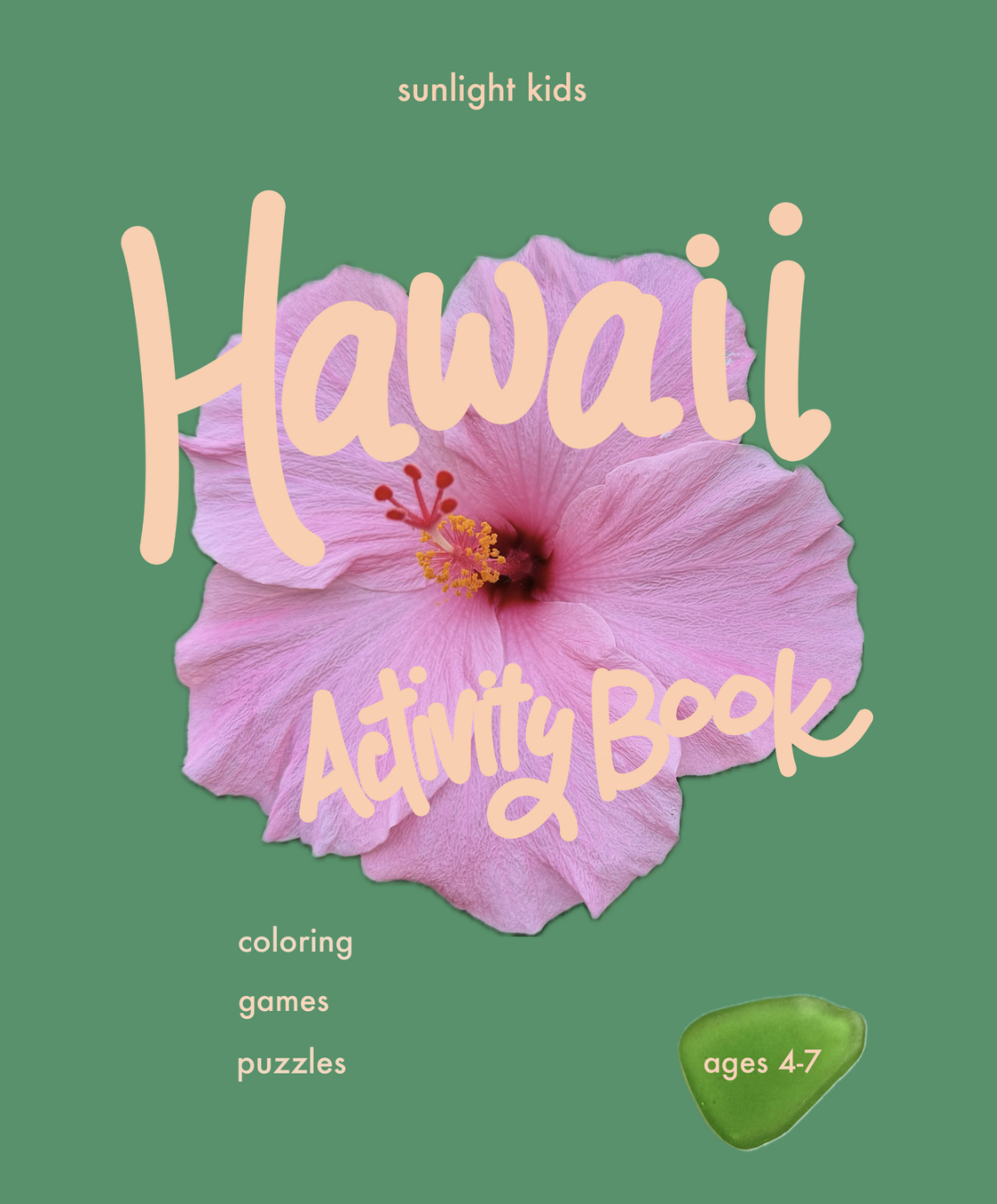
Ages 4–7 · Coloring, puzzles, mazes, games & fun facts — sized for ages 4–7.
- #2
Melissa & Doug Water Wow reusable books
Ages 2–4Still the best single thing you can put in front of a two- or three-year-old on a plane. A chubby pen fills with water, the pages reveal colour where it touches, and about five minutes after they finish the page fades back and they can do it again. Nothing to lose except the pen, nothing to stain, no adult required, and the whole thing is smaller than a paperback. On a transatlantic flight with a toddler this earns its place ahead of almost anything else in the bag. Weakness: there are only four or so scenes per book, so a kid who is engaged will cycle them and be bored by hour three — buy two different titles rather than one. The pen also leaks if it goes in a checked bag full of water; empty it or carry it on.
- #3
Usborne travel activity and wipe-clean books
Ages 3–7Usborne's travel-oriented activity and wipe-clean titles are the most consistently well-made things in this category. Thick board-like pages, clear illustration, genuinely thought-through activities, and small formats built to go in a bag rather than sit on a shelf. The wipe-clean editions in particular give you near-infinite reuse for one pen, which is the right economics for a family that flies more than once a year. Weakness: wipe-clean lives and dies by the pen. Lose it or let it dry out and the book is inert, and the replacement pens are rarely to hand at 35,000 feet. Tape a spare inside the cover before you leave. Several Usborne travel titles also lean on sticker sheets, which is the one component you least want on a plane.
- #4
Highlights Hidden Pictures compilations
Ages 5–9The best-value pick for the five-to-nine bracket, and the format most likely to hold a kid for a full hour unaided. Hidden Pictures needs no instructions, no reading ability, and no adult judgement about whether a page is finished — the objects are either found or they are not. The compilations run several hundred pages, so a single book covers a flight out, a flight home, and the airport in between, and there is an answer section for the ones that defeat everybody. Weakness: it is one format repeated at length, and a kid who does not click with seek-and-find will not warm to it over 300 pages. The thick compilations are also heavier and bulkier than a slim activity book, which matters if you are already at your carry-on limit.
- #5
Sunlight Puzzle Book for Kids: Easy
Ages 6–9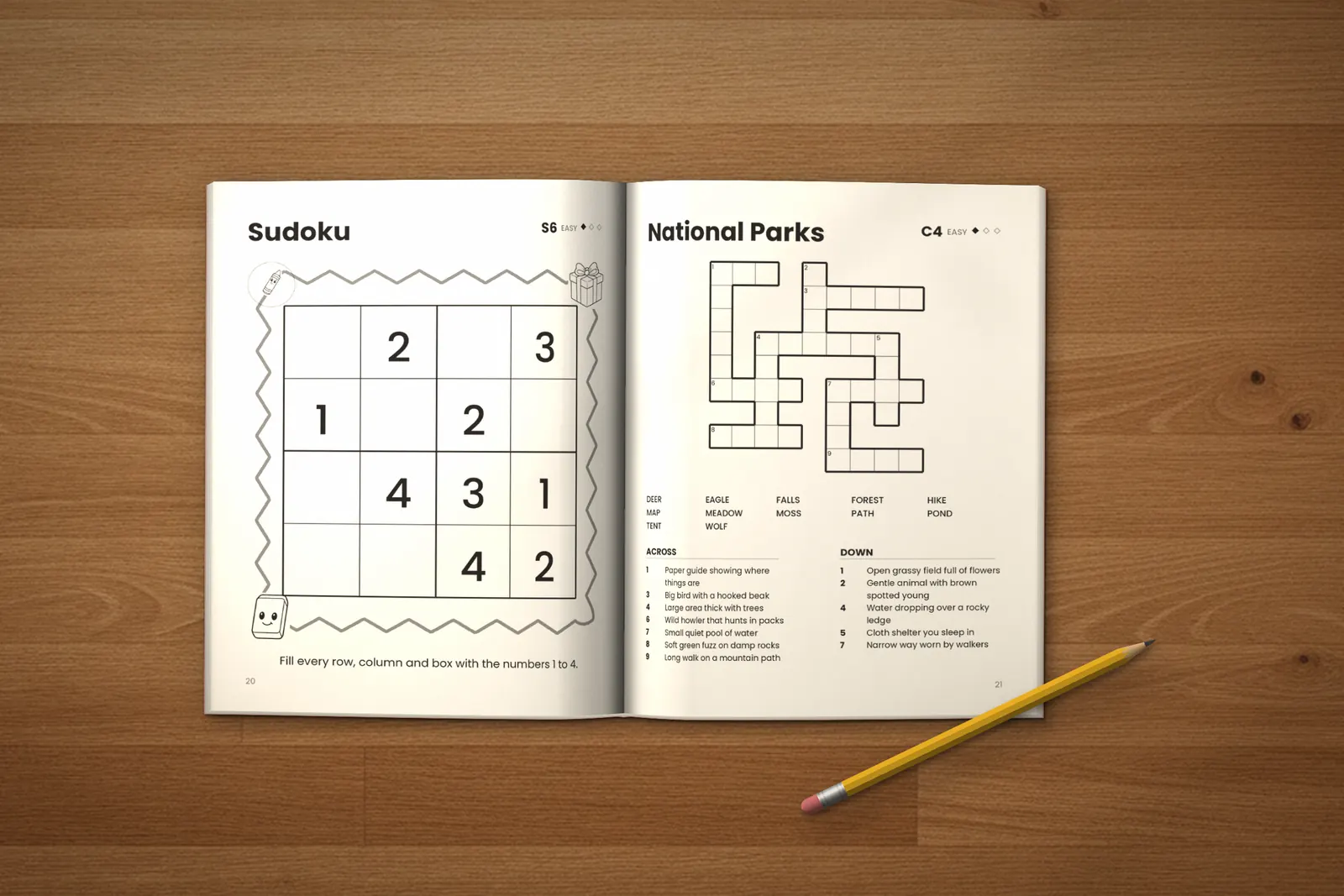
For the child who has outgrown coloring but is not going to sit still for a novel. Sudoku, crosswords, and word searches mixed through one 8 by 10 book, one puzzle per page in big clear type, with instructions written so a kid can teach themselves and a full answer key in the back so they can check their own work instead of asking you. The mix is the point on a long flight — a kid who stalls on a crossword flips forward to a word search rather than closing the book. Weakness: it is finished but not yet listed, so the button below reads Coming soon rather than taking you to checkout. It also needs a reader — a five-year-old will need help with the crossword clues, which defeats the purpose. If your child is under six, the destination books above are the better fit.
Paperback$10.99In a rush? Download the PDF now and print it at home.
What to look for in a travel activity book
One activity per page, start-and-stop
Flights are interrupted constantly — drinks cart, seatbelt sign, bathroom, landing. An activity that takes four minutes and is visibly finished survives that. A multi-page project that has to be built up over half an hour gets abandoned at the first interruption and never resumed. Flip through the preview and ask how many pages could be started and finished between the drinks cart and the snack.
Match the page count to the day, not the flight
People buy for the flight time and then get caught by everything around it: the ride to the airport, the security queue, the gate, the delay, the baggage carousel, the taxi. Reckon on double the flight duration in dead time, and pack more book than you think you need. A 120-page activity book that costs the price of two airport coffees is the cheapest insurance in your bag.
Think about what the book asks you to pack with it
The book is half the decision; the kit is the other half. A zip pouch with three or four chunky crayons, one pencil, and a small sharpener covers almost everything on this page and survives being sat on. Skip markers on planes. Skip anything with 40 loose pieces. And put the pouch in the seat pocket at the start of the flight rather than in the overhead bin, because you are not standing up.
Buy one book per child, and hold one back
Two children sharing one activity book on a plane is a fight, not an activity — there is no room to share a tray and no way to divide the crayons fairly. Buy one each. And if you have bought two books, keep the second one hidden until the point where the first one stops working, usually somewhere in the last hour. A new book produced at hour four is worth more than two books produced at hour one.
DIY vs buy
Printables are excellent for the padding around a trip and poor as the main event. Our free printable library covers a lot of the same ground — the restaurant busy kit, the rainy day activity pack, dot markers for the youngest — and printing a stack costs nothing, which makes it perfect for the airport, the hotel room, and the afternoon when the plan falls apart. What loose paper cannot do is survive a seat pocket: sheets slide, crease, fall between the seats, and get collected by cabin crew as rubbish. If you print for a flight, hole-punch the pages into a slim folder or clip them to a lightweight board so they behave like a book. For the flight itself, one bound book per child is the version that actually gets used.
Going somewhere specific?
Ages 2–5 · 4–7 · 7+ · Adults
Frequently asked questions
- What is the best activity book for a long flight?
- It depends almost entirely on age. Two to four: a Water Wow or another no-mess reusable book, because nothing is lost and nothing stains. Four to seven: a destination activity book about the place you are going, because the subject matter does half the work of holding attention. Six to nine: a thick mixed-puzzle or Hidden Pictures compilation they can work through alone. Above nine, most kids would rather have a book they chose themselves.
- How many activity books should I bring on a flight?
- One per child that they have already seen, plus one per child that they have not. The unopened one is your reserve for the last hour, which is the hour that actually decides how the flight went. Two books each is plenty for a day of travel; more than that and you are carrying weight you will not use.
- Are sticker books good for planes?
- Reusable static-cling sticker scenes are good; peel-and-stick sticker sheets are not. The difference is recovery. A cling sticker that lands on the floor can be picked up and reused, while a peel-and-stick sticker that lands anywhere is either gone or now attached to the seat. If you do bring a sticker book, bring the reusable kind, and keep the sheet in the seat pocket rather than loose on the tray.
- Crayons, pencils, or markers on a plane?
- Chunky crayons for under-fives, pencils for over-fives, markers essentially never. Crayons do not roll far, do not stain upholstery, and do not need sharpening. Regular round pencils roll off a tray on the first bank of the aircraft, so pack triangular or hexagonal ones. Markers will eventually meet a seat back, a sleeve, or a passport, and washable is a claim about fabric that has been washed, not about a seat that has not.
- At what age do activity books stop working on trips?
- Usually somewhere around nine or ten, when a child would rather choose their own entertainment than be handed something. The transition is smoother if you let them pick the book themselves at that age — puzzle compilations, logic puzzle books, and sketchbooks all extend the runway. Below that, a book chosen for the specific trip beats a generic one almost every time.
Sunlight Kids activity books — for every age.
Ages 2–5 · 4–7 · 7+ · Adults